Article: What is near-infrared light? How it differs from UV, and the heat in sunlight

What is near-infrared light? How it differs from UV, and the heat in sunlight
When it comes to beating the summer heat, many people think first of “UV protection.” But UV rays make up only a small part of sunlight. Much of the light we feel as heat when exposed to the sun is infrared, especially near-infrared light. This article explains what near-infrared light is, how it differs from UV, and how to deal with it.
What is near-infrared light?
Near-infrared light (NIR: near-infrared rays) is a type of invisible light contained in sunlight, accounting for about 42% of the solar energy that reaches the ground. Its wavelength is roughly 700–1400 nm, longer than visible light, and it is said to reach deeper layers of the skin than UV rays.
The breakdown of solar energy reaching the ground is roughly as follows.
- Ultraviolet (UV / 280–400 nm): about 5%
- Visible light (400–700 nm): about 43%
- Near-infrared (700–1400 nm): about 42%
- Other infrared (1400–4000 nm): about 11%


Values obtained by integrating the ASTM G173-03 reference solar spectrum (AM1.5 global, ground level) by wavelength range. Totals do not equal 100% due to rounding.
In other words, much of the energy we feel as “scorching” heat in the sun comes not from UV but from infrared, especially near-infrared light.
The difference between UV and near-infrared light
Put simply, UV is “light that causes sunburn and spots,” and near-infrared is “light we readily feel as heat.”
| Ultraviolet (UV) | Near-infrared (NIR) | |
|---|---|---|
| Wavelength range | 280–400 nm | 700–1400 nm |
| Share of sunlight | About 5% | About 42% |
| Depth reached | Mainly the skin surface to the dermis | Said to reach deeper layers than UV |
| Main effects | Sunburn, spots | Felt as heat; effects on the skin are still being researched |
| Common measures | Sunscreen, UPF materials | Near-infrared-cut materials (check the numbers) |
The important point is that standard UV-protection products (sunscreen and clothing with a UPF rating) are not designed to block near-infrared rays. The UPF number tells you nothing about near-infrared light.
What range the three labels SPF, PA and UPF actually protect is explained in detail in What percentage of sunlight does sunscreen block?
Heat from sunlight and heatstroke
Heatstroke becomes more likely not only because of temperature and humidity, but also when heat received from sunlight (radiant heat) is added. This is why the heat index (WBGT) is calculated by taking radiant heat into account in addition to temperature and humidity.
Heatstroke occurs when core body temperature (the temperature of the brain and internal organs) rises and the body's temperature regulation can no longer keep up. When core body temperature exceeds 38°C, symptoms such as dizziness and headache appear, and above 40°C it can become life-threatening, with impaired consciousness (heat stroke).
The troublesome part is that core body temperature cannot be lowered quickly once it rises. Ice and cooling goods can lower the skin's surface temperature, but heat trapped in the body's core does not escape right away. That is why, along with drinking water, taking salt and resting frequently, ways to reduce the amount of sunlight you receive (moving into the shade, wearing a hat, wearing clothing that covers your skin) are important.
*For heatstroke symptoms and first aid, please also check the Ministry of the Environment's heatstroke prevention information website.
The relationship between near-infrared light and the skin is still being researched
The relationship between near-infrared light and the skin is being studied in dermatology. While UV acts mainly on the skin surface, near-infrared light is said to reach deeper layers, and its effects are still being investigated. No conclusion has been reached.
Also, compared with UV, near-infrared light varies less with the seasons and continues to reach us in autumn and winter.
How to deal with near-infrared light
Ways to reduce near-infrared light are to block sunlight and to cover your skin with materials that block near-infrared rays. When choosing a material, check the following three points.
- Check the numbers — Standard UV-protective clothing does not target near-infrared rays. Choose products that show a “near-infrared protection rate” and the wavelength range measured.
- Think about the area covered — The torso is the part with the largest area exposed to sunlight. Covering the torso with innerwear and the head and neck with a hat reduces a wide area of sun exposure.
- Regardless of the season — Near-infrared light does not drop much in autumn and winter, so be mindful of sunlight all year round, not just in summer.
CORE SHIELD®, which blocks 87%+ of near-infrared rays
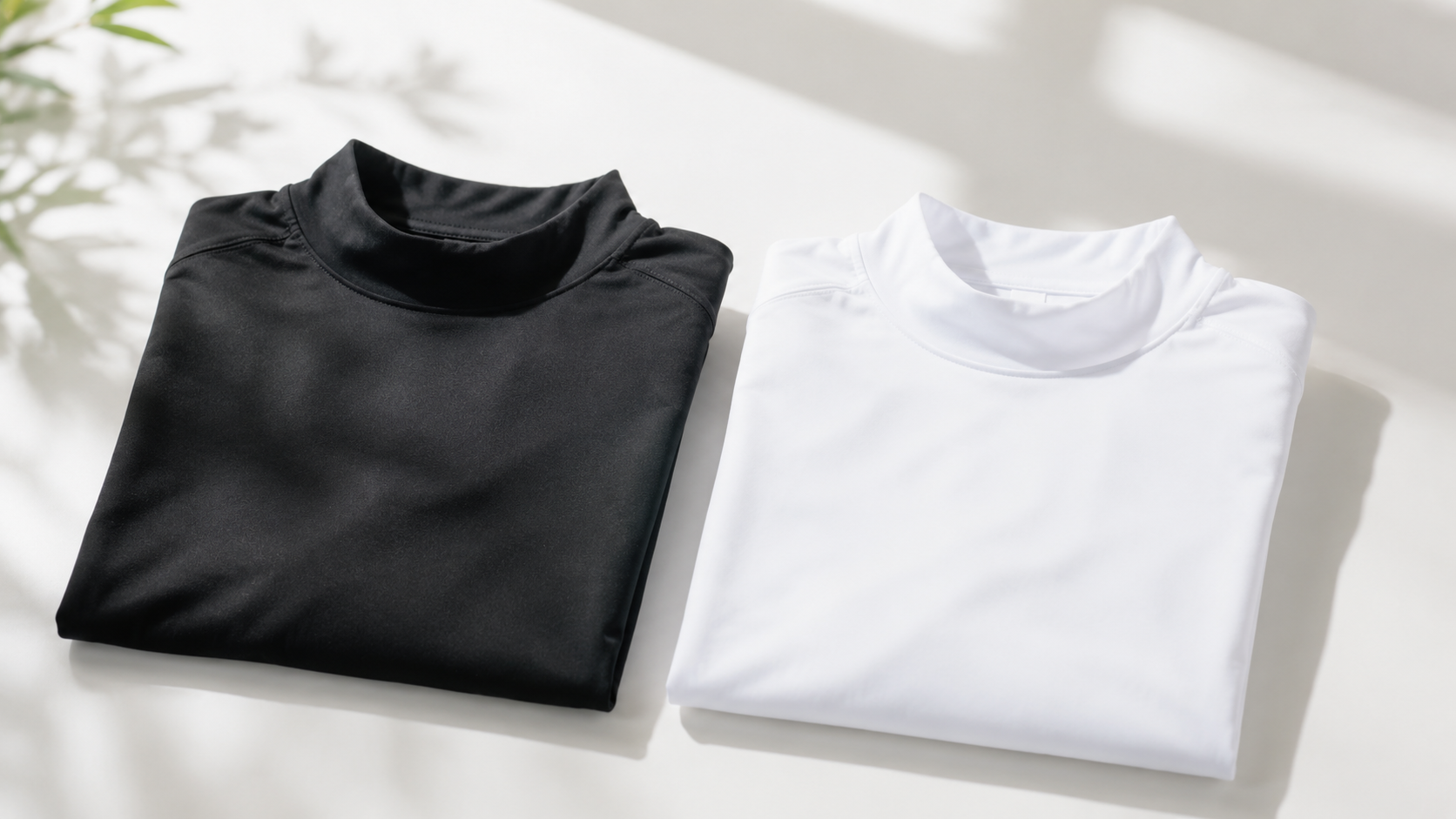
CORE SHIELD®, offered by our store, is a Japanese-made apparel brand that focuses on near-infrared light. With Trubeaute®, a functional fiber with special ceramic microparticles derived from rare metals kneaded into it, it blocks 87%+ of near-infrared rays (White 88.6% / Black 87.6%; measured on the fabric alone by the material manufacturer).
It also blocks 97%+ of UV rays, UPF 50+ (White 97.1% / Black 98.7%; tested on the fabric alone), and features cool-touch and moisture-wicking, quick-drying properties, making it well suited to summer outdoor activities such as golf, worksites, farm work and walks.
Summary
- Near-infrared light accounts for about 42% of sunlight reaching the ground, more than eight times UV (about 5%)
- It is light we readily feel as heat when exposed to the sun
- Standard UV-protection products do not cover it. Check near-infrared performance by the numbers
- It reaches us in autumn and winter too, so it is worth keeping in mind in every season
Beyond UV protection, take a look at the rest of the light — near-infrared light.
*The composition of sunlight in this article is based on values obtained by integrating the ASTM G173-03 reference solar spectrum (AM1.5 global, ground level, 280–4000 nm) by wavelength range. The wavelength ranges are defined as UV 280–400 nm, visible light 400–700 nm, near-infrared 700–1400 nm and other infrared 1400–4000 nm.
*The relationship between near-infrared light and photoaging (wrinkles, sagging) is still being researched and is not an established conclusion.
*CORE SHIELD® is clothing and does not prevent or improve age spots, wrinkles or sagging.