
Revisiting Mandatory Heatstroke Prevention in the Workplace in Its Second Summer: Beyond Structural Improvements to "Equipment"
In June 2025, the revised Ordinance on Industrial Safety and Health came into force, making workplace heatstroke measures a legal obligation backed by penalties. Now in the second year since it took effect, many worksites have probably finished setting up reporting systems and manuals. Yet the damage caused by workplace heatstroke continues to grow. This article briefly summarizes the key points of the obligation, then explains what comes after setting up the system: how to think about the equipment that protects each person working on site.
The key points of the obligation in three minutes
Under the revised Ordinance on Industrial Safety and Health (Article 612-2), effective June 1, 2025, employers whose work takes place in certain hot environments are required to (1) set up and communicate a reporting system and (2) establish and communicate procedures to prevent symptoms from worsening.
The rule covers work expected to continue for more than one hour at a time, or more than four hours a day, in an environment with a WBGT (heat index) of 28 or higher or a temperature of 31°C or higher. Besides outdoor construction, landscaping and farm work, indoor work in factories, warehouses and kitchens where air conditioning is less effective may also be covered. There are no exemptions by industry or company size.
Employers are required to do two main things.
1. Set up and communicate a reporting system Designate, for each workplace, a contact point and person in charge so that workers who notice heatstroke symptoms in themselves or in others can report them, and make this known to the workers concerned.
2. Establish and communicate procedures to prevent worsening Define, for each workplace, steps such as “removing the worker from the task,” “cooling the body” and “seeing a doctor when necessary,” along with emergency contacts and where to take the person, and make these known to the workers concerned.
Failing to take these measures may lead to penalties under the Industrial Safety and Health Act (imprisonment of up to six months or a fine of up to 500,000 yen), as well as corrective guidance from the Labor Standards Inspection Office and civil liability for breach of the duty of care.
*For details and the latest information on the regulations, please always check primary sources such as the Ministry of Health, Labour and Welfare.
Damage is still increasing — 2025 set a record
In 2025, the first year of the obligation, the number of workers killed or injured by heatstroke at work (four or more days off) reached a record 1,803 (final figures from the Ministry of Health, Labour and Welfare).
A reporting system minimizes the damage when heatstroke occurs. Reporting systems and response procedures are an essential lifeline, but on their own they do not reduce the number of cases. The rise in casualties shows that, as heat waves intensify, investment in prevention is needed alongside systems for responding after the fact.
The key to prevention: reducing the heat the body takes in
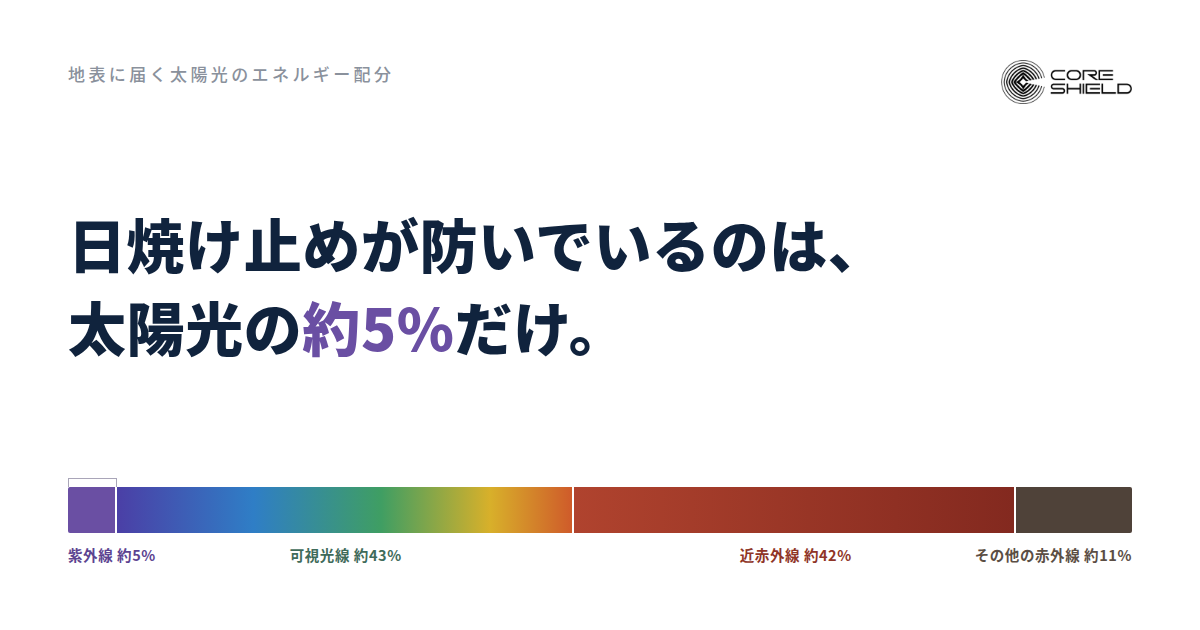
Heatstroke occurs when core body temperature (the temperature inside the body) rises and the body's temperature regulation can no longer keep up. About 42% of sunlight (wavelengths of roughly 700–1400 nm) is near-infrared light, which we readily feel as heat.
As the WBGT includes radiant heat in its assessment, the heat received from direct sunlight and reflected sunlight is an essential factor when considering heat risk at work. Standard UV-protective clothing targets UV rays; near-infrared rays are outside its scope (see “What is near-infrared light?”). And because core body temperature is hard to bring down once it rises, prevention that keeps it from rising matters (“What is core body temperature?”).
How to think about worksite equipment: “block” × “dry”
If fan-equipped work clothes are equipment that dries sweat with airflow, heat-shielding innerwear is equipment that blocks sunlight with fabric. Because their roles differ, they can be used together.
Fan-equipped work clothes evaporate sweat using outside air drawn in by the fan, so their cooling efficiency drops on extremely hot days when the outside temperature approaches body temperature. Adding innerwear that blocks near-infrared rays on the skin side lets you cover the torso, which receives sunlight, with fabric. Wearing a hat as well covers both the head and the torso, the areas exposed to the sun the longest.
Selecting and using worksite equipment is also covered in “Heat protection for field and farm work.”
CORE SHIELD®, chosen as equipment for employees
Our store's CORE SHIELD® is Japanese-made innerwear that blocks both near-infrared and UV rays. Using Trubeaute®, a special fiber with special ceramic microparticles derived from rare metals kneaded into it, it blocks 87%+ of near-infrared rays (White 88.6% / Black 87.6%; measured on the fabric alone by the material manufacturer).
The functional components are kneaded into the fibers, so they do not wash off with sweat. It has also been adopted by companies as equipment supplied to their staff.
For bulk purchases by companies and organizations, invoice payment and other inquiries, please contact us via Corporate inquiries.
Summary
- Since June 2025, workplace heatstroke measures (setting up and communicating reporting systems and procedures to prevent worsening) have been mandatory, with penalties
- The rule covers work in WBGT 28+ or 31°C+ that lasts more than one hour continuously or more than four hours a day; indoor work may also be covered
- Even after the obligation began, workplace heatstroke casualties increased, reaching a record 1,803 in 2025
- Along with the response system, review measures that reduce the amount of sunlight workers receive
- Combining “heat-shielding innerwear to block sunlight” with “fan-equipped work clothes to dry sweat” is one option
Worker safety is not just about legal compliance; it is the foundation of on-site productivity and corporate trust. In this second summer, review your site's equipment along with your systems.