How to Choose Heatstroke Prevention Innerwear: A Thorough Guide to the Differences Between Cooling and Heat-Shielding Types
Functional innerwear has become a summer essential. Yet we often hear people say, “I'm wearing cooling innerwear but I'm still hot,” or “I don't know which one to choose.” Innerwear sold for heatstroke prevention comes in two types with different mechanisms, and knowing the difference makes choosing easier. This article explains how each type works and the criteria for choosing.
There are two types of heatstroke prevention innerwear
Heatstroke prevention innerwear can be broadly divided into two types: the “cooling type” and the “heat-shielding type.” The former is innerwear that makes you feel cool; the latter is innerwear that blocks sunlight with its fabric.
| Cooling type | Heat-shielding type (near-infrared cut) | |
|---|---|---|
| Mechanism | Uses materials that feel cool at first touch (cool-touch) or evaporative heat | Blocks the near-infrared rays in sunlight with the fabric |
| Nature of the effect | Works on sensation (how it feels) | Reduces the amount of sunlight you receive |
| How long it lasts | Harder to feel once sweat dries or the skin gets used to it | A property of the fabric, so it does not change while you wear it |
| Best suited for | Indoors, shade, short outings | Long activities in direct sunlight |
Why cooling innerwear can feel like it “doesn't work”
Most cooling innerwear does not lower your body temperature; it makes you feel cool.
Cool-touch materials create a “cool” sensation by quickly drawing heat away the moment they touch the skin. But this is a sensation at the moment you put it on, and in direct sunlight heat from the sun keeps reaching the body. Feeling “cool when I put it on, but hot in the blazing sun after all” is not a product defect but a difference in mechanism.
Indoors or in air-conditioned environments, the cooling type is perfectly comfortable. The issue is situations with long exposure to direct sunlight, such as golf, worksites and farm work. Here, besides how it feels, measures that reduce the amount of sunlight you receive — in other words, the heat-shielding type — become an option.
How the heat-shielding type (near-infrared cut) works
Heat-shielding innerwear blocks, with its fabric, near-infrared rays, which make up about 42% of sunlight.
Near-infrared light is the kind of light we readily feel as heat when exposed to the sun. Standard UV-protective innerwear (with a UPF rating) uses an index aimed at UV rays (about 5% of sunlight); near-infrared rays are outside its scope. The properties of near-infrared light are explained in detail in “What is near-infrared light?”
When choosing the heat-shielding type, check that the “near-infrared cut rate” is shown with a number and measurement conditions (wavelength range and who measured it). Products that simply say “heat-shielding” or “cool” do not tell you their actual performance.
Three criteria for choosing
Criterion 1: Choose by situation If you are mostly indoors or going out briefly, the cooling type is enough. If you are active in direct sunlight for an hour or more, choose the heat-shielding type. Products with both functions (near-infrared cut + cool-touch) can be used in any situation.
Criterion 2: Choose by whether the numbers are backed up Choose products whose figures, such as “near-infrared cut rate ◯%,” are shown together with measurement conditions. Distinguish them from products described only with image-based expressions.
Criterion 3: Choose by how long the effect lasts If the function comes from a surface treatment on the fabric, the effect may decline with repeated washing. With types where the functional components are kneaded into the fibers, there is no concern about them washing off with sweat. Also consider whether you will replace it after one season or use it for a long time.
Recommendations by situation
- Golf: You are in direct sunlight for 4–5 hours of play, so the heat-shielding type is the first choice. Under a polo shirt, a sleeveless type is comfortable. Measures for summer rounds in general are summarized in “Heatstroke prevention for golf: a summary.”
- Worksites and farm work: For long, heavy work, breaks and water and salt intake come first. On top of that, covering the torso, which receives sunlight, with heat-shielding innerwear is one option. When combining it with fan-equipped clothing, check the manufacturer's recommended way of wearing it.
- Commuting, walks and shopping: If you are outdoors for 30 minutes or less, the cooling type is fine. A parasol or hat can cover the rest. Measures for commuting and walking around the city are explained in detail in “Why are summers in the city dangerous?”
- Outdoor spectator sports and events: You sit in the blazing sun for hours, so go for the heat-shielding type plus frequent hydration.
CORE SHIELD®, which blocks 87%+ of near-infrared rays
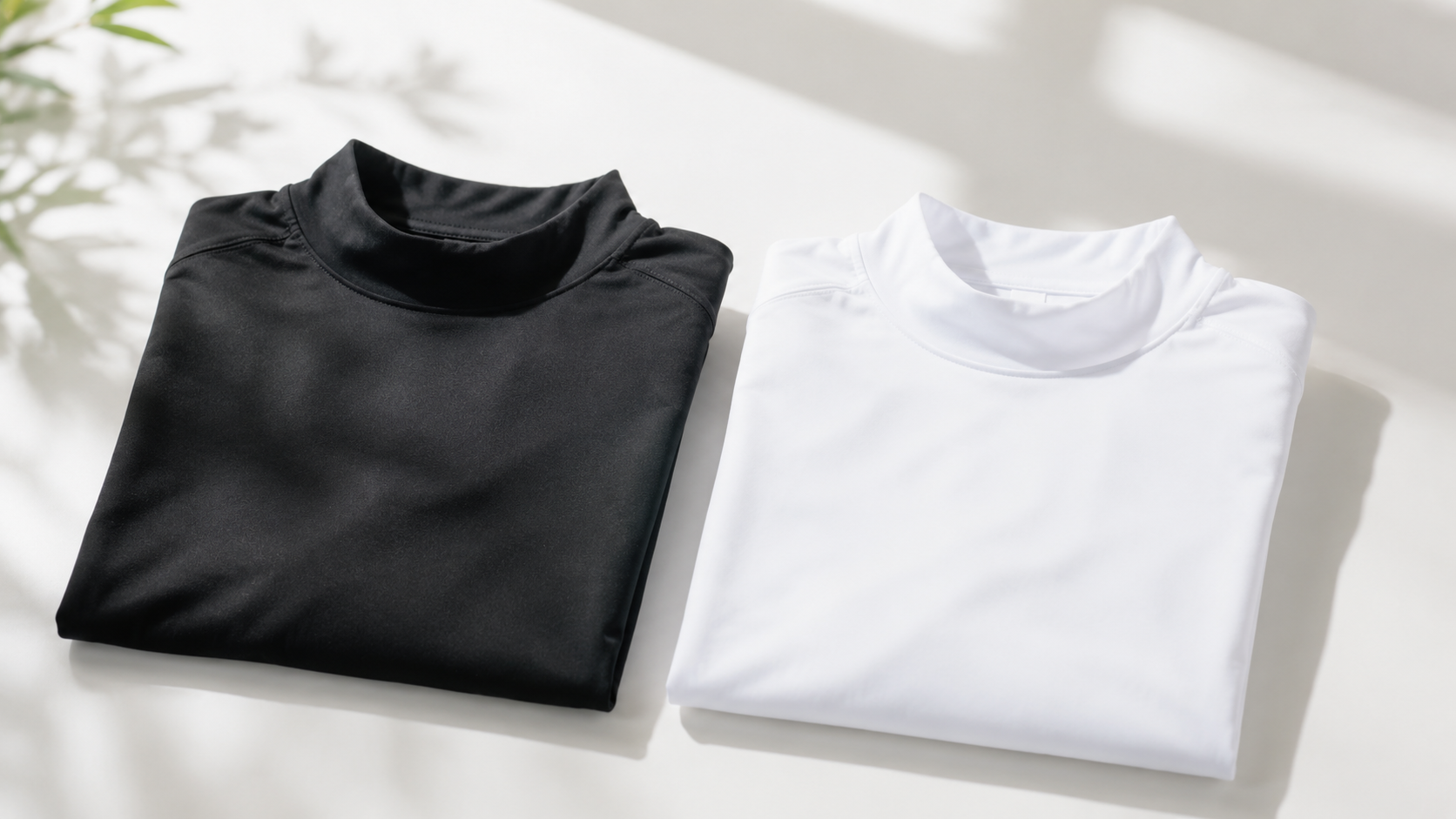
Our store's CORE SHIELD® is Japanese-made innerwear classified as the heat-shielding type. It uses Trubeaute®, a special fiber with special ceramic microparticles derived from rare metals kneaded into it, and blocks 87%+ of near-infrared rays (White 88.6% / Black 87.6%; measured on the fabric alone by the material manufacturer).
The functional components are kneaded into the fibers, so they do not wash off with sweat, and it also blocks 97%+ of UV rays (UPF 50+). It also features cool-touch and moisture-wicking, quick-drying properties. It is a piece we would like people who found cooling innerwear not enough to try.
Summary
- Heatstroke prevention innerwear works differently depending on whether it is the cooling type or the heat-shielding type
- The cooling type works on sensation; it does not block sunlight itself
- For long activities in direct sunlight, choose the near-infrared-cut heat-shielding type
- The three criteria are situation, backed-up numbers, and how long the effect lasts
Choose the type that suits the situations you will use it in, and get through this summer safely.