Heatstroke Prevention for Golf: A Summary of Summer Attire, Essentials, and On-Course Precautions
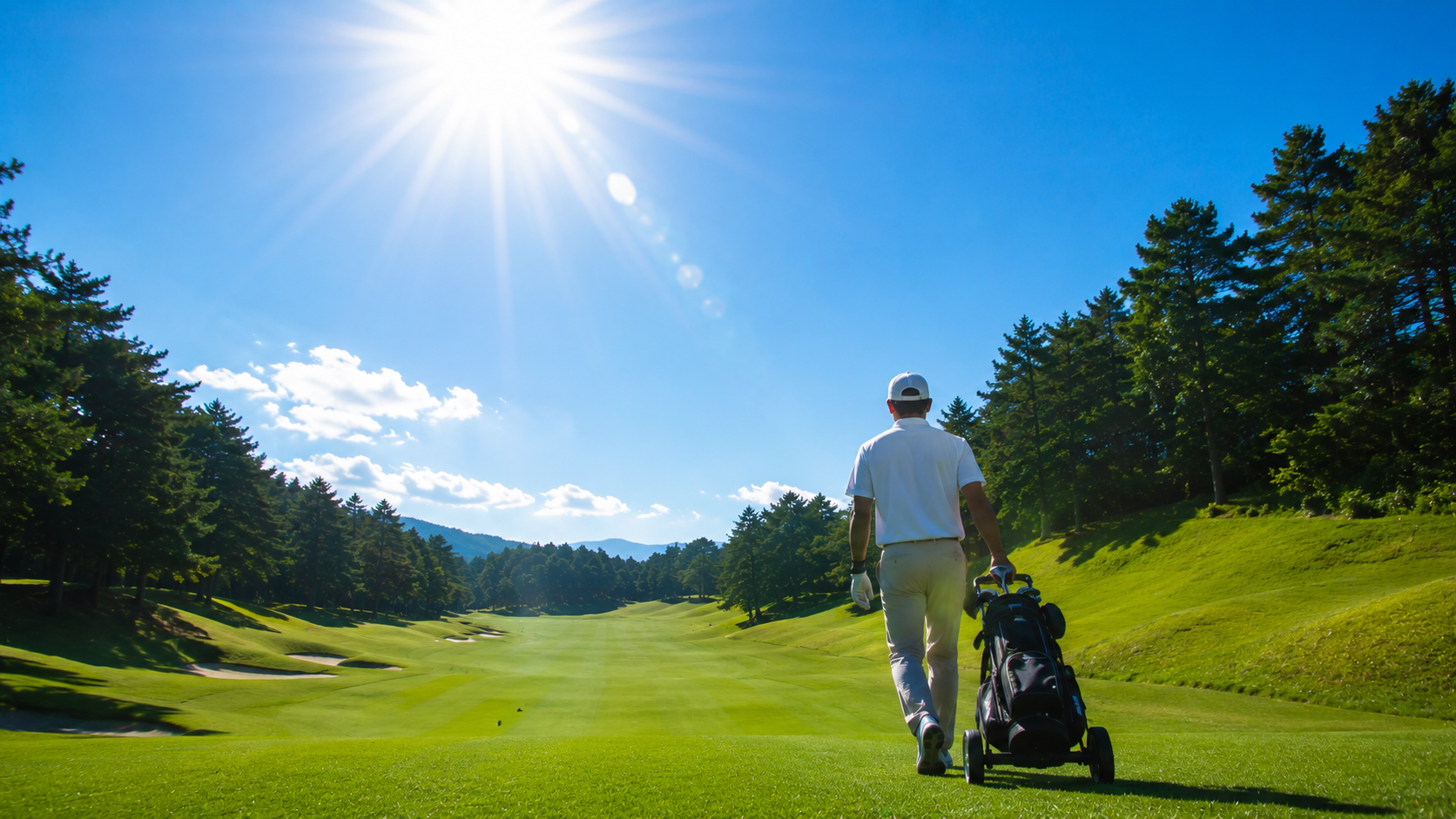
Summer golf is actually a sport with a very high risk of heatstroke. A round lasts 4–5 hours on a course with nothing to block the sun, and you walk around 10 km. And when you are focused on play, you tend to notice changes in your body late. So that a round meant to be fun does not end with an ambulance ride, this article summarizes heatstroke prevention for summer golf in three stages: up to the day before, clothing and things to bring, and during the round.
Why golf makes heatstroke more likely
Golf's particular risk comes from three overlapping factors: long hours, direct sunlight, and difficulty noticing symptoms.
First, the length of time. Two halves of just over two hours each is a kind of sun exposure you rarely experience in daily life. Second, the environment. There is almost no shade on the fairway, and in addition to the air temperature you are exposed to heat from sunlight (radiant heat) for hours. Third, delayed awareness. Concentrating on your score and play, and not wanting to trouble your playing partners, you tend to ignore the signs that “something is a bit off.” Because core body temperature is hard to bring down once it rises (for details, see “What is core body temperature?”), preparing in advance to keep it from rising is especially important in golf.
Preparing up to the day before the round
Heatstroke prevention starts the day before tee-off. The key points are sleep, alcohol, and physical condition.
- Get enough sleep: Lack of sleep is a typical factor that reduces the body's ability to regulate temperature. Even with an early start, get at least six hours
- Go easy on alcohol the night before: Alcohol is a diuretic, so you start the next morning dehydrated. Heavy drinking the night before is the biggest enemy of a summer round
- Breakfast and fluids: Skipping breakfast means starting without your initial store of salt and water. Drink regularly even before you leave home
- Have the courage to cancel when you feel unwell: Playing with a fever, diarrhea or a hangover sharply raises the risk of heatstroke
Choosing what to wear
The basics of summer golf clothing are both blocking sunlight and releasing heat.
- Innerwear: In golf, with 4–5 hours of direct sunlight, cool-touch-only innerwear does not block sunlight itself. Covering your torso with heat-shielding innerwear whose fabric blocks the near-infrared rays in sunlight is one option. Under a polo shirt, a sleeveless type that releases heat easily is comfortable (the differences between types are explained in “How to choose heatstroke prevention innerwear”)
- Polo shirt: Choose highly breathable, quick-drying materials. White and light colors, which absorb less heat, are an advantage
- Hat: Essential. A wide-brim hat also protects your neck and ears
- Others: Sunglasses (UV through the eyes also affects fatigue), breathable gloves, quick-drying socks
Things to bring
Items worth keeping in the cart for a summer round.
- At least 1.5–2 L of drinks (not just water or tea, but also sports drinks or oral rehydration solution that replenish salt and electrolytes)
- Salt tablets or umeboshi (pickled plums)
- Cooling towels and ice packs (ice in a cooler box comes in handy)
- Sunscreen (reapply at the turn)
- A spare undershirt and towel (changing at the turn makes the back nine easier)
- One bottle of oral rehydration solution, just in case
Points to watch during the round
The trick is to make “drink before you're thirsty” and “drink at every hole” mechanical rules.
- Drink at every hole: Thirst is a sign that dehydration has already begun. Make it a habit to take a sip every time you step onto the tee
- Take salt as well: On days when you sweat heavily, water alone is not enough. Take a salt tablet or similar about once an hour
- Use shade and the cart: While waiting, go to the cart or the shade of a tree. Avoiding direct sunlight even for short moments adds up
- At the turn: Replenish water and salt at lunch and change clothes if you can. Beer is a diuretic and speeds dehydration, so if you drink, keep it small and drink at least the same amount of water
- Check yourself and each other: Dizziness, headache, nausea, repeated yawning and sweat suddenly stopping are danger signs. Look out for your playing partners as well as yourself. If something feels wrong, your body comes before your score — stop playing without hesitation and head to the clubhouse. If someone seems dazed, contact the course staff immediately and call an ambulance
*You can check the day's heat index (WBGT) on the Ministry of the Environment's “Heatstroke Prevention Information” website. On days at the “danger” level, changing to an early-morning round or postponing is also an option.
CORE SHIELD®, sun-protection innerwear chosen by golfers
Our store's CORE SHIELD® is Japanese-made innerwear designed for exactly the kind of “long hours × direct sunlight” environment that summer golf presents. Using Trubeaute®, a special fiber with special ceramic microparticles derived from rare metals kneaded into it, it blocks 87%+ of near-infrared rays (White 88.6% / Black 87.6%; measured on the fabric alone by the material manufacturer).
With cool-touch, moisture-wicking and quick-drying fabric, UPF 50+ and 360° stretch that does not hinder your swing, it also comes in a sleeveless type that is less visible under a polo shirt. It has been featured in golf media such as GOLF BROS and GEW.
Summary
- Golf is a high-risk heatstroke environment where long hours, direct sunlight and delayed awareness overlap
- Prevention starts the day before. Sleep, moderate drinking and breakfast determine your tolerance on the day
- The basic outfit is near-infrared-cut innerwear + breathable wear + a hat
- During the round, make “a sip at every hole” a mechanical rule, together with salt
- If something feels wrong, your body comes before your score. Stop playing without hesitation
With proper preparation, summer is also the best season for golf, making the most of the long days. Enjoy it with thorough precautions.