Article: Can a black undershirt be worn under a white polo shirt?
Can a black undershirt be worn under a white polo shirt?
Wearing a black base layer under a white polo shirt—it’s a common combination for both golf and workwear.
What often concerns people in that situation is color transfer.
The real concerns: sweat and rain
Color almost never transfers when the fabric is dry. The problem arises when it gets wet.
Sweating or getting caught in the rain—when dark-colored fabric is pressed against light-colored fabric while wet, dyes can migrate. Summer rounds on the golf course or outdoor work are situations where these conditions are exactly met.
The test result: Grade 5
Below are the results of colorfastness tests conducted by the Kaken Test Center for the fabric used in CORE SHIELD®.
| Test Item | Test Method | Result |
|---|---|---|
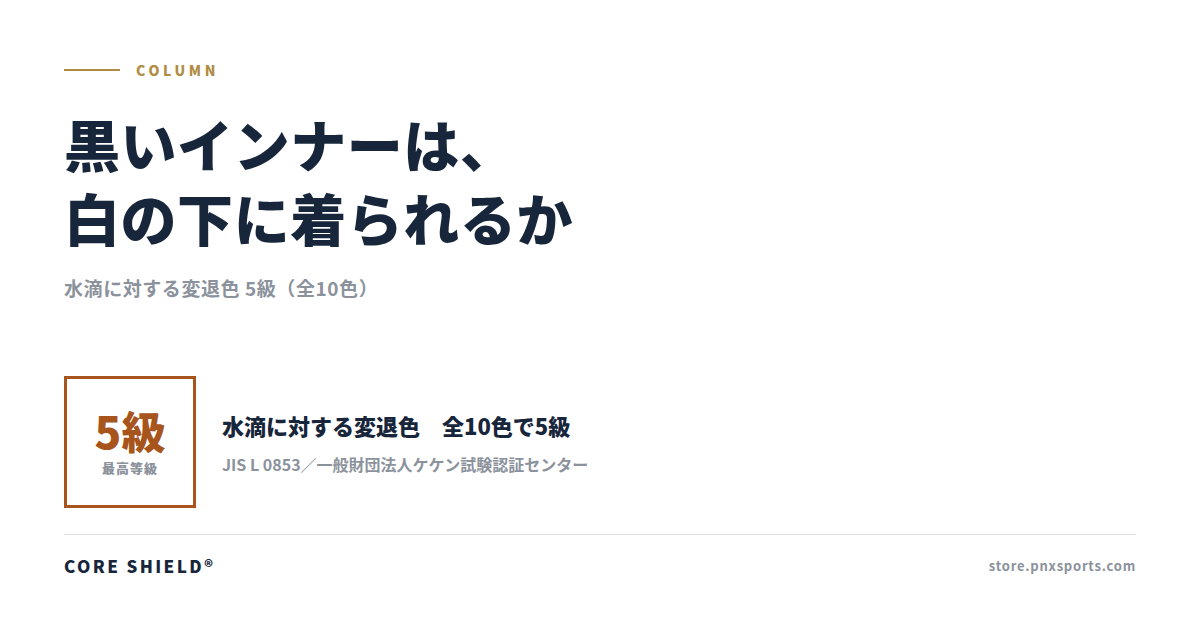
| Change in color against water droplets | JIS L 0853 | Grade 5 (all 10 colors) |
| Color bleeding | Daimaru Method I | Grade 4-5 to 5 |
| Oxygen bleaching | JIS L 0889 | Grade 4 to 4-5 |
| Chlorinated water | JIS L 0884 Method A | Grade 3-4 to 4-5 |
Grades range from 1 to 5, with 5 indicating the least amount of change. For change in color against water droplets, all 10 colors tested were Grade 5.
What this "Grade 5" actually measures
This is an important point, so I want to be precise.
JIS L 0853, "Colorfastness to water droplets," is a test that evaluates how much the fabric itself changes color when water droplets are applied. It does not directly measure whether color transfers onto white fabric.
The test more closely related to transfer susceptibility is the one for "color bleeding," which observes whether dye leaches out when wet. This scored Grade 4-5 to 5.
To summarize, here are the three figures we currently have:
- Even if wet, the fabric's own color does not change (Change in color against water droplets: Grade 5)
- When wet, dye is unlikely to leach out (Color bleeding: Grade 4-5 to 5)
- We do not yet have figures directly measuring how much color transfers when in contact with white fabric
I could omit that third point and flatly claim, "It's safe to wear under white garments." But I won't do that.
Our policy is to present measured data along with the testing conditions. If we were to make it look like we have data we don't actually have, the credibility of the figures we *do* provide would be compromised.
We have requested that the material manufacturer conduct tests directly measuring transfer to other fabrics (colorfastness to "staining" via friction and sweat). Once those figures are available, I will update this article.
Things to keep in mind, regardless
Even if test grades are high, results can vary depending on how you use the product. Here are three points to note:
For the first 1-2 washes, please wash separately from other colored items. With any garment, excess dye is released during the first wash.
Do not leave the item in contact with other clothing while wet for an extended period. Tossing your clothes into a bag while still wet after a round and leaving them overnight is the worst-case scenario. Simply spreading them out to dry makes a difference.
After being in a pool or hot spring, wash the garment soon. In the test for chlorinated water (JIS L 0884 Method A), some colors scored Grade 3-4. This is lower than other categories, so please keep that in mind if you expose the garment to chlorine.
A note on dimensions
The same report includes data on dimensional change after washing.
-0.7% (JIS L 1930 C4M/C4H Method A / line drying). This is less than 1%. The fabric is highly resistant to losing its shape after washing.
However, this refers to the shape remaining unchanged, not the functional effectiveness remaining unchanged. We don't know how the UV and near-infrared shielding rates perform after washing without testing them separately. We have requested this data from the developer as well; I will write about it once the numbers are in.
Many brands claim their "effects last after washing," but almost none provide the specific number of cycles and the corresponding data. As soon as we can provide that, we will.
※All figures listed are test values for the fabric alone (Trubeaute® C). Test results refer to the provided samples and do not guarantee the quality of the entire lot.
※This product is an article of clothing and is not intended to prevent or improve spots, wrinkles, or sagging.
Recommended reading
Looking at "Quick-Dry" through data