Why Hats Are Essential for Heatstroke Prevention: How to Choose One and the New Standard of "Near-Infrared Cut"
As heatstroke prevention gear, a hat is not “nice to have” but essential. However, not every hat works the same. Choose the wrong one and you may end up “hot even with a hat on” or “stuffy and more uncomfortable.” This article explains why hats help prevent heatstroke, and a new selection criterion worth considering in addition to shade and ventilation: near-infrared cut.
Why protecting the head matters
The head is the part of the body that receives direct sunlight for the longest time and at the angle closest to perpendicular.
The midsummer sun beats down from high overhead. The sides of the body receive different amounts of sunlight depending on the angle to the sun, but the top of the head faces the sun throughout the day. The head is also close to the brain, and when heat builds up in the hair and scalp, it quickly leads to strong discomfort and a “foggy-headed” feeling. Going without a hat in the blazing sun is like leaving the body's control center exposed to heat.
About 42% of sunlight is near-infrared light, which we readily feel as heat. How much near-infrared light a hat's fabric lets through has to be checked separately from UPF (the UV index) (for details, see “What is near-infrared light?”). The role of a hat is to block the sunlight you receive from above.
Is it true that “black hats are hot”?
It is half true and half a misunderstanding. What matters is less the surface color than whether the fabric lets heat through to the inside and whether trapped heat can escape.
Black absorbs light easily, so it is true that the surface temperature of a black hat rises more than a white one. But what matters to the wearer is not the surface temperature but the amount of heat that reaches the head. If the fabric lets sunlight (especially near-infrared light) through to the inside, the head heats up regardless of color; conversely, if the fabric itself cuts near-infrared rays, the difference due to surface color becomes smaller. And if the hat has vents or a similar structure to release hot air inside, it also avoids stuffiness.
In short, rather than “white or black,” it makes sense to choose a hat by whether the fabric lets heat through and whether hot air can escape.
Four criteria for choosing a hat for heatstroke prevention
Choose by four criteria: brim width, ventilation, near-infrared cut, and fit/chin strap.
1. Brim width A cap (front brim only) keeps your field of view clear, but leaves the nape, ears and sides of the face exposed. A hat with an all-around brim blocks direct sunlight not only on the head but also around the neck. The longer you spend in the blazing sun, the more a hat makes sense.
2. Ventilation No matter how well a hat blocks sunlight, if hot air and moisture build up inside, it becomes uncomfortable and the scalp gets sweaty. Check for vents, mesh materials and a lining that absorbs and dries sweat.
3. Near-infrared cut (a new criterion) The usual “UV cut” labeling on hats covers UV rays (about 5% of sunlight); near-infrared rays (about 42%) are outside its scope. A hat whose fabric itself blocks near-infrared rays reduces, with fabric, the near-infrared light you receive from above. When choosing, check whether a “near-infrared cut rate” is shown as a number.
4. Fit and chin strap Golf courses and worksites are often windy, and a hat that blows off ends up not being worn. Size adjustment and a chin strap are practical points that determine whether you keep wearing it every day.
Choosing a hat for different situations
- Golf: For 4–5 hours of direct sunlight, an all-around-brim hat is ideal. Also look for a quick-drying lining and light weight so you can focus on play even when sweating (for measures for the whole round, see “Heatstroke prevention for golf: a summary”)
- Worksites: When wearing a helmet, use an inner cap worn under the helmet; for work without a helmet, choose a wide-brim hat. Meeting safety standards comes first
- Farm work: Because you often lean forward, a brim wide and deep enough to cover the back of the neck is important. A chin strap is practically essential
- Walks and daily life: Since you wear it every day, look for light weight, washability and a design that goes with your clothes. A hat you actually want to wear is, in the end, the best heatstroke measure
Cover top and bottom with a hat and innerwear
Cover the head and neck with a hat and the torso with heat-shielding innerwear — covering the large areas that receive sunlight, top and bottom, is the way to think about gear in direct sunlight.
The head and the torso are the parts that receive sunlight the longest. Think about covering both, not just one. Combining a near-infrared-cut hat with innerwear reduces a wide area of sun exposure (for choosing innerwear, see “How to choose heatstroke prevention innerwear”).
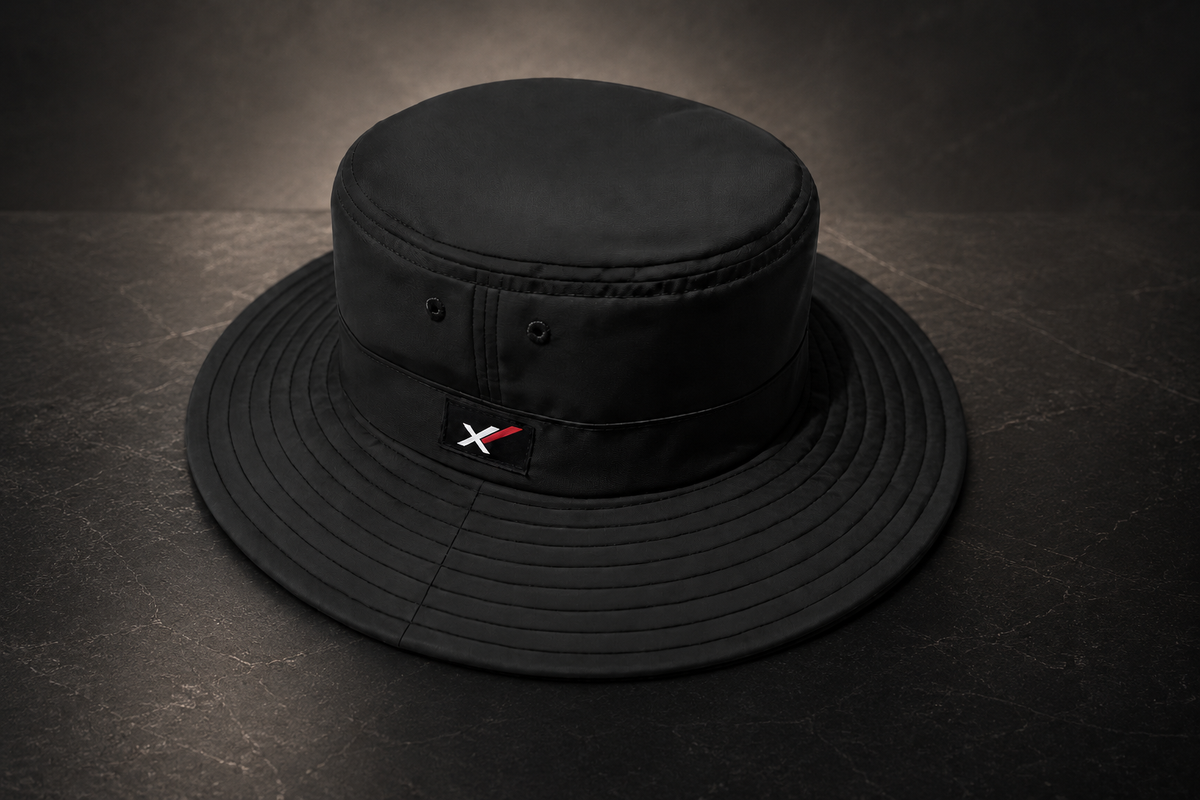
A hat made with near-infrared-cut fabric, now from CORE SHIELD®
From CORE SHIELD®, whose innerwear is loved by many, comes a new hat made with the same near-infrared-cut fabric.
Like the innerwear, it uses Trubeaute®, a special fiber with special ceramic microparticles derived from rare metals kneaded into it. The near-infrared protection rate is 67.8–68.0%, and UV protection is UPF 50+ (Black and Beige; tested on the fabric alone). Its all-around brim covers you down to the nape of the neck. The functional components are kneaded into the fibers themselves.
It went on sale on July 25, 2026. CORE SHIELD bucket hat product page
Summary
- The head receives sunlight from directly above for long periods
- Choose a hat not only by color but by whether the fabric lets sunlight through and whether hot air can escape
- The four criteria are brim width, ventilation, near-infrared cut and fit
- Usual UV-cut labeling does not cover near-infrared rays
- A hat (head) and innerwear (torso) together cover a wide area that receives sunlight
This summer, upgrade your hat from “a piece of cloth for shade” to “heat-shielding gear.”
Related reading: For heat measures on the golf course, the article What makes summer golf risky for seniors on GOLF100, our media site for senior golfers, explains why people in their 60s and 70s become more vulnerable to heat and offers measures by age group (in Japanese).