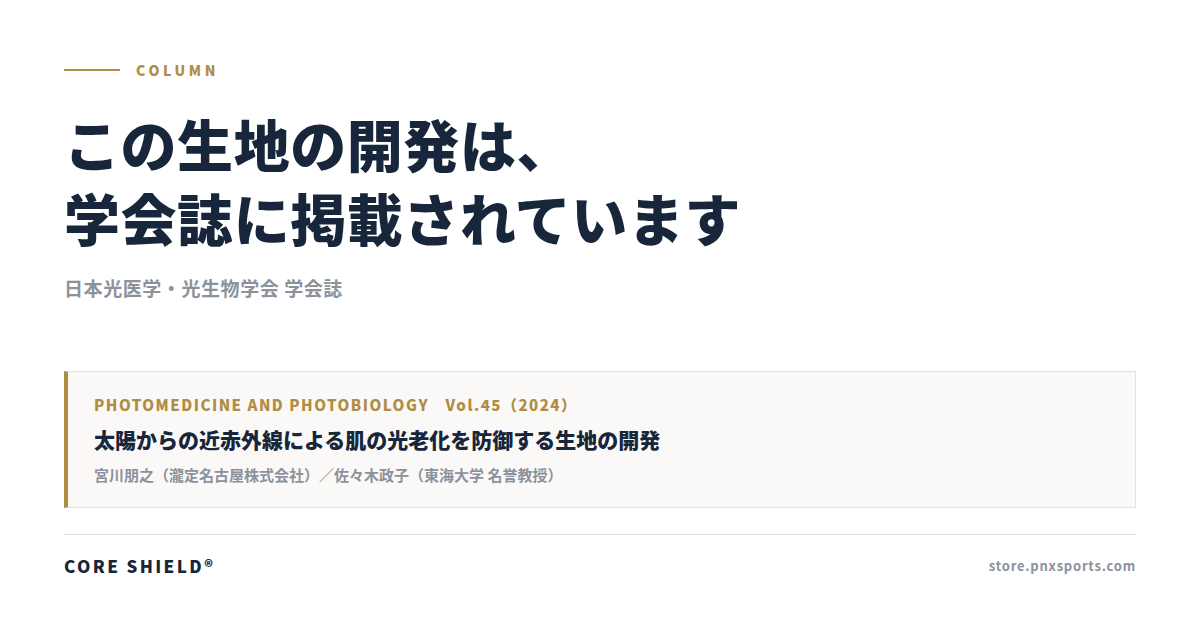
The development of this fabric has been published in an academic journal.
The development of Trubeaute®, the fabric used in CORE SHIELD®, has been documented in a paper published in the journal of the Japanese Society for Photomedicine and Photobiology. Here is an overview of its contents.
Journal and Authors
| Journal | Photomedicine and Photobiology, Vol. 45 (2024) Japanese Society for Photomedicine and Photobiology |
|---|---|
| Title | Development of fabric that prevents photoaging of the skin caused by near-infrared rays from the sun |
| Authors | Tomoyuki Miyagawa (High-Performance Product Development and Sales Section, Takisada-Nagoya Co., Ltd.) Masako Sasaki (Professor Emeritus, Tokai University) |
Scope of the Paper
The paper covers the development of the fabric and the measurement of its performance.
- Polyester fibers infused with ceramic fine particles that absorb near-infrared rays (cesium tungsten oxide nanoparticles = CWO®)
- Polyester fibers infused with titanium oxide fine particles, which act as a UV absorber
- Fabric created by combining these two types of thread, with UV and near-infrared shielding rates measured
- A comparison of how shielding rates change across four types of fabric with different weaves and weights
Measurement Methods
The paper even specifies the testing methods used.
| Test Method | In compliance with JIS L 1925:2019 |
|---|---|
| Equipment | Spectrophotometer: V-670 manufactured by JASCO Corporation |
| Ultraviolet Rays | Shielding rates for UV-A 360nm / UV-B 305nm |
| Near-Infrared Rays | Calculated from the average transmittance across all wavelengths from 800 to 2600nm |
The formula for calculating the near-infrared shielding rate is also clearly stated:
Near-infrared shielding rate (%) = 100 - (Average transmittance across all wavelengths in the near-infrared region)
Additionally, tests were conducted using an artificial solar lighting system (XC-500EFSS manufactured by Seric Ltd.) to measure temperature increases with a thermal camera.
References in the Paper
Several studies regarding the relationship between near-infrared rays and the skin are cited within the paper:
- Otsuka Pharmaceutical: Research results on the inhibitory effect of near-infrared rays (IRA) on human epidermal cell proliferation and the elucidation of its mechanism (2020)
- Shiseido: Elucidation of the mechanism by which infrared rays negatively affect the skin (2021)
- Akari Morita: Environmental Factors and Wrinkles, Journal of Cosmetic Science of Japan, Vol. 37, No. 1 (2013)
- Yohei Tanaka, Yuichiro Tsuda, Makoto Kawashima: The Pros and Cons of Near-Infrared Rays, Japanese Journal of Dermatology, Vol. 130, No. 9 (2020)
Based on these studies, the paper raises the question of whether protection against near-infrared rays is necessary in addition to ultraviolet protection.
The Research is Still Ongoing
We want to be clear about this point:
The publication of this paper does not mean that the product's effectiveness has been officially certified. Publication in a journal simply means that the research has been shared within the academic community.
Furthermore, research into the relationship between near-infrared rays and skin photoaging is still in the developmental stages. The paper itself notes that "it is not yet widely known that near-infrared rays are a cause of skin photoaging."
What we can do is measure our fabric and disclose those figures along with the measurement conditions. We believe we cannot and should not claim anything beyond that.
※ All stated values are test results for the fabric alone. They do not indicate the effectiveness during actual wear.