Why are UV-protection garments often black?
When you look for UV-protective apparel, all you see is black or dark navy. Why such dark colors for summer? There is a reason. And that reason comes with side effects.
The easiest way to block ultraviolet rays
Make the fabric a darker color.
Dark-colored dyes and pigments absorb UV rays very well. Therefore, if the material and thickness are the same, black blocks UV rays more effectively than white. The reason UV-protective apparel so often comes in dark colors is that it is the most reliable and cheapest method.
However, dark colors retain heat
It is not just UV rays that dark colors absorb. They also readily absorb visible light. The absorbed light is converted into heat. This is why black clothing feels hot in the summer.
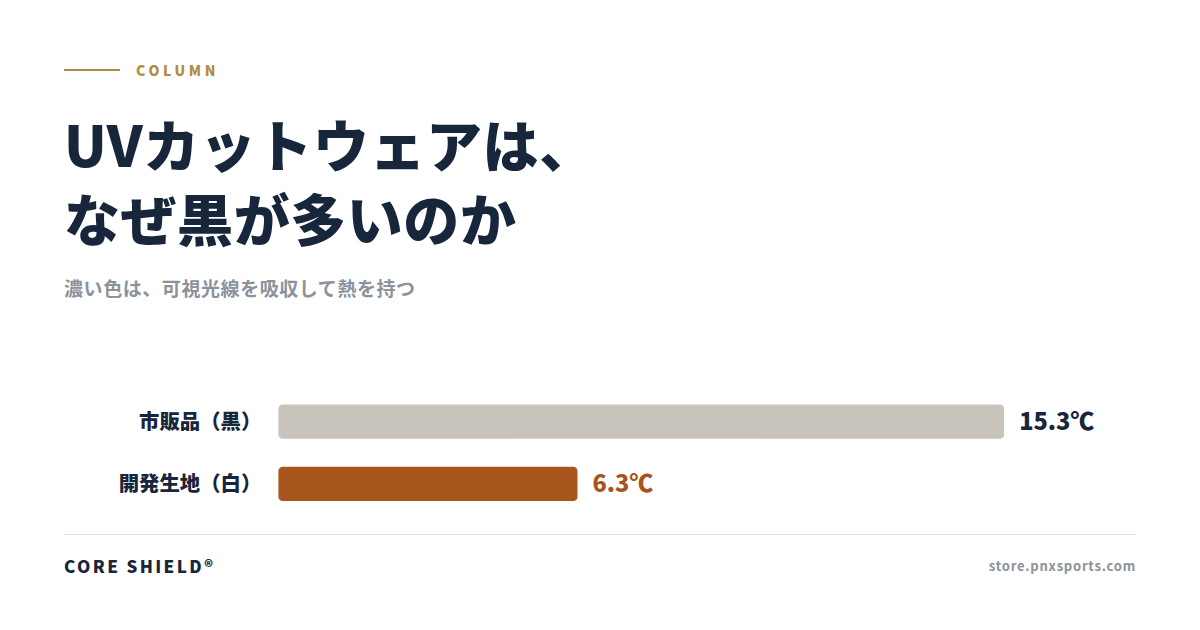
There is an experiment that measured this difference. A study published in the journal of the Japanese Photomedicine and Photobiology Society compared temperature increases after 30 minutes of exposure to an artificial sunlight lamp.
Figure 1: Temperature increase after 30 minutes of artificial sunlight exposure
Temperature difference due to light absorption and heat generation (JIS L 1926:2019). This is a comparison of arm cover fabrics; it differs from the fabric used in CORE SHIELD® innerwear. Source: Tomoyuki Miyagawa, Masako Sasaki: Development of fabric to protect skin from photoaging caused by near-infrared rays from the sun, Photomedicine and Photobiology, Vol. 45 (2024)
While commercially available black arm covers showed a 15.3°C increase, the developed white fabric showed only a 6.3°C increase. It was reported that while the UV shielding rate remained nearly identical, the temperature increase was 9.0°C lower.
This comparison was conducted using fabric made for arm covers and is different from the fabric used in CORE SHIELD® innerwear. Please view this as an experimental result reported in a research paper.
Letting visible light pass while absorbing only near-infrared rays
So, how can you block near-infrared rays while keeping the fabric white?
The material used is called CWO®. It is a ceramic fine particle developed by Sumitomo Metal Mining Co., Ltd., originally used in heat-shielding films applied to building and car windows.
The fact that it can be used on windows means that it allows visible light to pass through. If it weren't transparent, it wouldn't work as a window. Furthermore, it selectively absorbs only near-infrared rays.
Figure 2: Transmittance of polycarbonate containing CWO®

*Measurement example using polycarbonate resin (provided by Sumitomo Metal Mining Co., Ltd.). This does not indicate the performance of this product's fabric.
Looking at the graph, while it transmits over 60% in the 400–600nm visible light range, it drops sharply past 700nm. You can block only near-infrared rays without having to use dark colors. This is the nature of this material.
That’s why white is fine
The fact that CORE SHIELD® is based on white is not a matter of design preference. The order of operations is: we can make it white because we use a material that produces the required numbers without having to be dark.
By combining yarn that absorbs near-infrared rays with yarn impregnated with titanium oxide that reflects ultraviolet rays, we achieve the required levels for both while keeping the fabric white.
| Item | Measurement Wavelength Range | Result |
|---|---|---|
| UV Shielding Rate | 290–400nm | 98.0% |
| UPF | 290–400nm | 50+ |
| Near-Infrared Shielding Rate | 800–2600nm | 77.1% |
Choose dark colors, or solve it through materials. We chose the latter.
* All values listed are test values for the fabric alone (Trubeaute® C / White). They do not indicate the effect during wear.
* The relationship between near-infrared rays and photoaging is still under research in the field of dermatology. This product is clothing and does not prevent or improve spots, wrinkles, or sagging.