
I did not choose the highest-performance fabric.
The fabric used for CORE SHIELD® has the lowest near-infrared shielding rate among the four types developed. We chose it for a specific reason.
The research paper presents four types of fabric
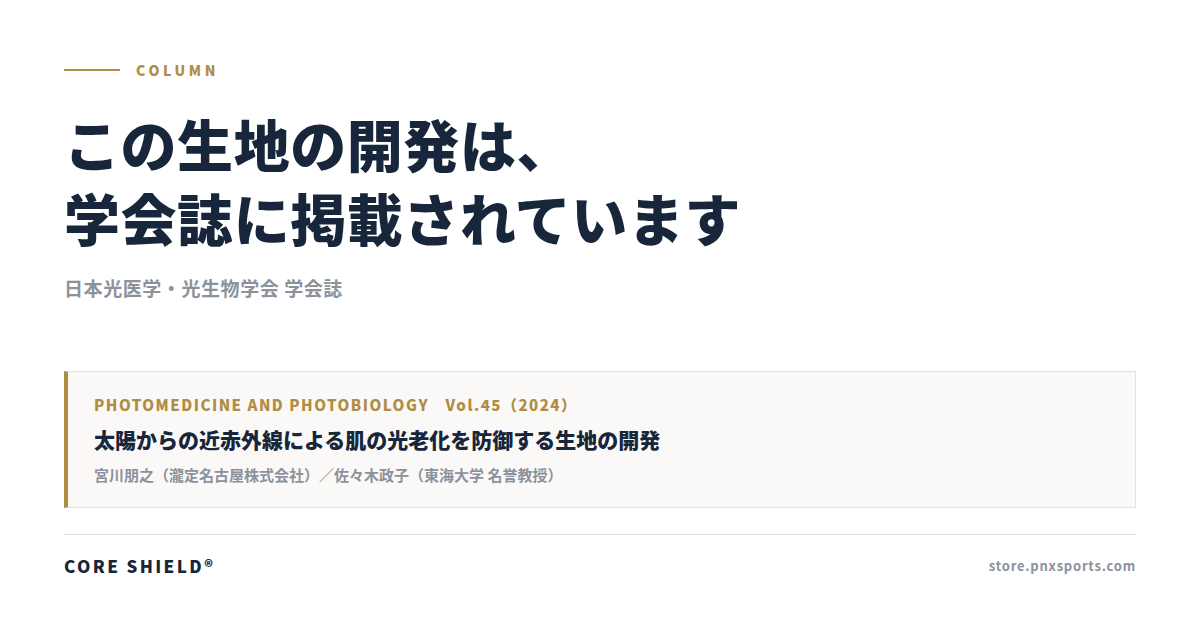
The development of this fabric was published as a research paper in the journal of the Japanese Society for Photomedicine and Photobiology. In that paper, four types of fabric (Trubeaute A–D) with different structures and weights were compared.
Figure 1: The four developed fabrics and their near-infrared shielding rates
Measurement wavelength range: 800–2600nm / Compliant with JIS L 1925:2019 / Test values for the fabric alone. Source: Tomoyuki Miyagawa, Masako Sasaki: Development of a fabric that protects skin from photoaging caused by near-infrared rays from the sun, Photomedicine and Photobiology, Vol. 45 (2024)
We use C
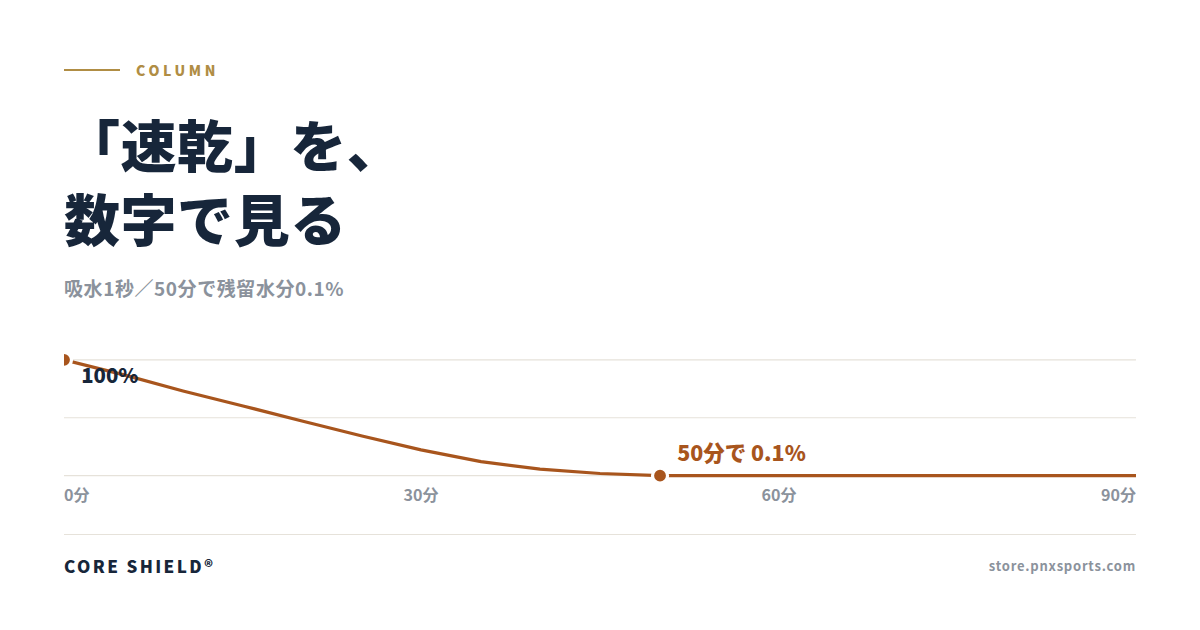
It is a double-knit pique with a basis weight of 164g/㎡. It is the lightest of the four types and has the lowest near-infrared shielding rate at 77.1%.
| A | B | C | D | |
|---|---|---|---|---|
| Structure | Smooth | Plated Jersey | Double Pique | Pique |
| Basis Weight | 190g/㎡ | 198g/㎡ | 164g/㎡ | 175g/㎡ |
| NIR Shielding Rate | 85.7% | 84.7% | 77.1% | 80.1% |
| UPF | 50+ | 50+ | 50+ | 50+ |
We know how to increase the numbers
The conclusion of the paper is this: the denser the fabric and the higher the basis weight, the higher the near-infrared shielding efficiency. In fact, type A, which was the highest, weighed 190g/㎡ and reached 85.7%.
In other words, if we were only chasing numbers, we could just use a thick, heavy fabric. We know how to do it.
However, this is innerwear
CORE SHIELD® innerwear is designed to be worn under polo shirts or work uniforms. It is not intended to be worn as a single layer.
Thick, heavy fabric produces high numbers. But when you wear something over it, it becomes bulky. It is difficult to wear for long periods during the summer. If it cannot be worn comfortably, the shielding rate is meaningless.
The 164g/㎡ figure for C is the lightest of the four types. The double pique has a textured surface, which minimizes skin contact and allows for airflow.
We chose the one that is wearable
We could have chosen the 85.7% fabric and labeled it "industry-leading." In fact, that would have made for better-looking numbers.
But what we wanted to create was innerwear you can wear every day. We sacrificed 8 points to prioritize comfort.
Whether or not this decision was correct is something for those who wear it to decide. At the very least, we are transparent about the reasons for our choice.
The values for the four types of fabric are all as published in the aforementioned paper. Measurements are compliant with JIS L 1925:2019, with a measurement wavelength range of 800–2600nm. These are test values for the fabric alone and do not indicate effectiveness when worn.
※ All stated values are test results for the fabric alone (Trubeaute® C / White). They do not indicate effectiveness when worn.
※ Research on the relationship between near-infrared rays and photoaging is still in progress in the field of dermatology. This product is an item of clothing and is not intended to prevent or improve spots, wrinkles, or sagging.