What does the UPF50+ rating measure?
When choosing UV-cut apparel, most people look for the "UPF50+" label. However, few places explain what specific range this number actually measures. We would like to discuss what the UPF rating covers and what it does not.
UPF stands for "Ultraviolet Protection Factor"
UPF (Ultraviolet Protection Factor) is an indicator of how effectively a textile blocks ultraviolet rays. Measurement methods are defined by the JIS L 1925 standard in Japan, and AS/NZS 4399 in Australia and New Zealand.
UPF50 means that the ultraviolet radiation passing through the fabric is reduced to 1/50th or less. The higher the number, the more effective it is at blocking UV rays.
Measuring the 290–400nm range
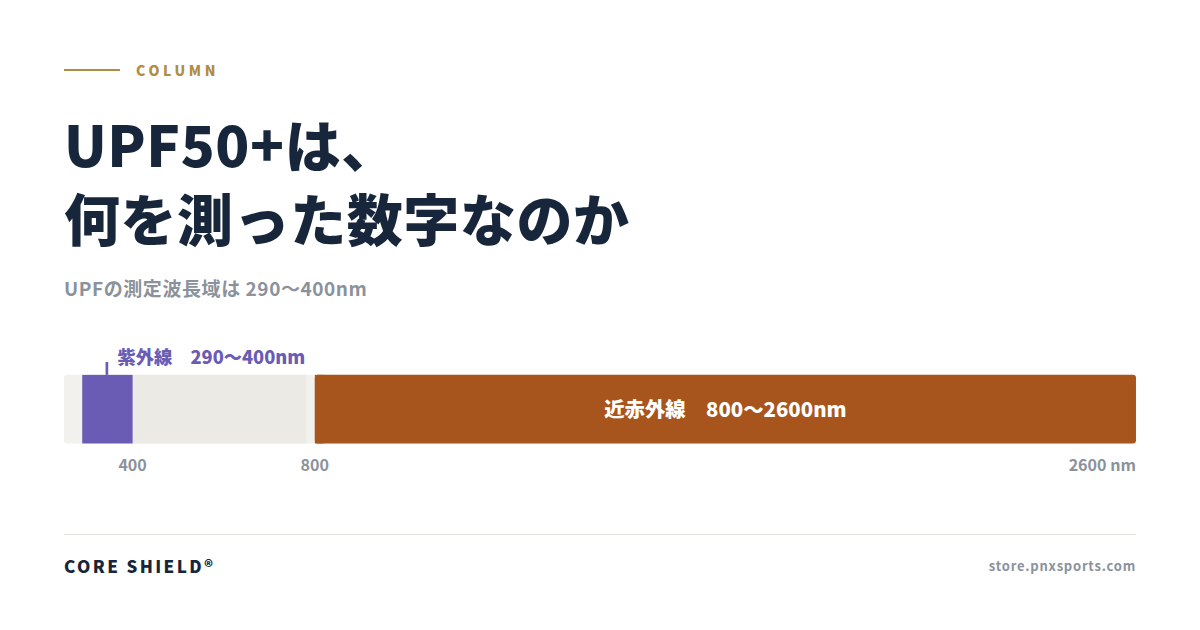
This is the main point of today's discussion: The measurement wavelength range for JIS L 1925 is 290–400nm—the ultraviolet spectrum.
Sunlight contains a significant amount of light with longer wavelengths, including visible light and near-infrared rays beyond that. Of the sunlight that reaches the Earth's surface, ultraviolet rays account for approximately 5%, while near-infrared rays account for about 40%.
The diagram below shows the 290nm to 2600nm range at actual scale.
Figure 1: Sunlight wavelength range and the range measured by UPF
The horizontal width represents the actual ratio of the wavelength ranges. The UPF measurement range (JIS L 1925) is 290–400nm.
The ultraviolet band accounts for less than 5% of the total spectrum. The UPF rating only addresses this narrow band.
To avoid any misunderstanding, this is not a flaw in the UPF system. UPF functions accurately as an indicator for ultraviolet rays. It isn't that it's lacking; it's simply measuring something different.
UPF50+ has no rating above it
There is one more thing that is useful to know: UPF50+ is the maximum rating. Anything with a UPF higher than 50, whether it is 55 or 80, is labeled as "50+."
In other words, you cannot compare two products labeled "UPF50+" based on this number alone, as the scale stops there.
So, what about the remaining light?
Near-infrared rays are invisible and do not cause sunburn, making them easy to ignore even while being exposed to them. Unlike ultraviolet rays, which largely remain in the epidermis, near-infrared rays are known to reach deeper skin layers, and their relationship with photoaging has been a subject of research in dermatology in recent years.
However, research in this field is still ongoing, and no definitive conclusions have been reached.
The other number we provide
In addition to ultraviolet rays, CORE SHIELD® measures fabric performance across the near-infrared band.
| Item | Measurement Range | Result |
|---|---|---|
| UV Blocking Rate | 290–400nm | 98.0% |
| UPF | 290–400nm | 50+ |
| Near-Infrared Blocking Rate | 800–2600nm | 77.1% |
All measurements are conducted in accordance with JIS L 1925:2019 (using a Jasco V-670 spectrophotometer). The near-infrared value is measured separately outside the UPF range.
There are things that "UPF50+" alone cannot tell you. To fill that gap, we provide two separate figures.
※ The values listed are based on tests of the fabric alone (Trubeaute® C / White). They do not indicate the actual effects when worn.
※ The relationship between near-infrared rays and photoaging is still under research in the field of dermatology. This product is clothing and is not intended to prevent or improve blemishes, wrinkles, or sagging.