The Pitfalls of Autumn Golf: Even if it gets cooler, the sun is just as strong.
September has arrived. With the peak of the heat behind us, many golfers will likely be heading out to the course more often. However, "feeling cooler" and "the sun becoming weaker" are not the same thing. In this article, we look at data to confirm just how much light you are actually exposed to during autumn rounds.
Spring and Autumn: The Top Choices for Golfers
In a survey asking 544 amateur golfers which month they consider to be their "best season," the results were as follows:
- 1st place May: 39% (212 votes)
- 2nd place October: 24% (129 votes)
- 3rd place April: 10% (54 votes)
- 4th place November: 6% (31 votes) / Tied for 4th September: 6% (31 votes)
About 88% of respondents chose spring or autumn. Meanwhile, August ranked last with only 6 votes. In other words, most golfers avoid the height of summer and concentrate their rounds in the coming season. Autumn is actually when you stand under the sun for the longest time throughout the year.
September's Ultraviolet Rays Are Still "Strong"
So, how strong is the autumn sun? Let’s look at the "monthly average of the maximum daily UV index" recorded by the Japan Meteorological Agency.


The UV index is categorized as "low" for 1–2, "moderate" for 3–5, "high" for 6–7, and "very high" for 8–10.
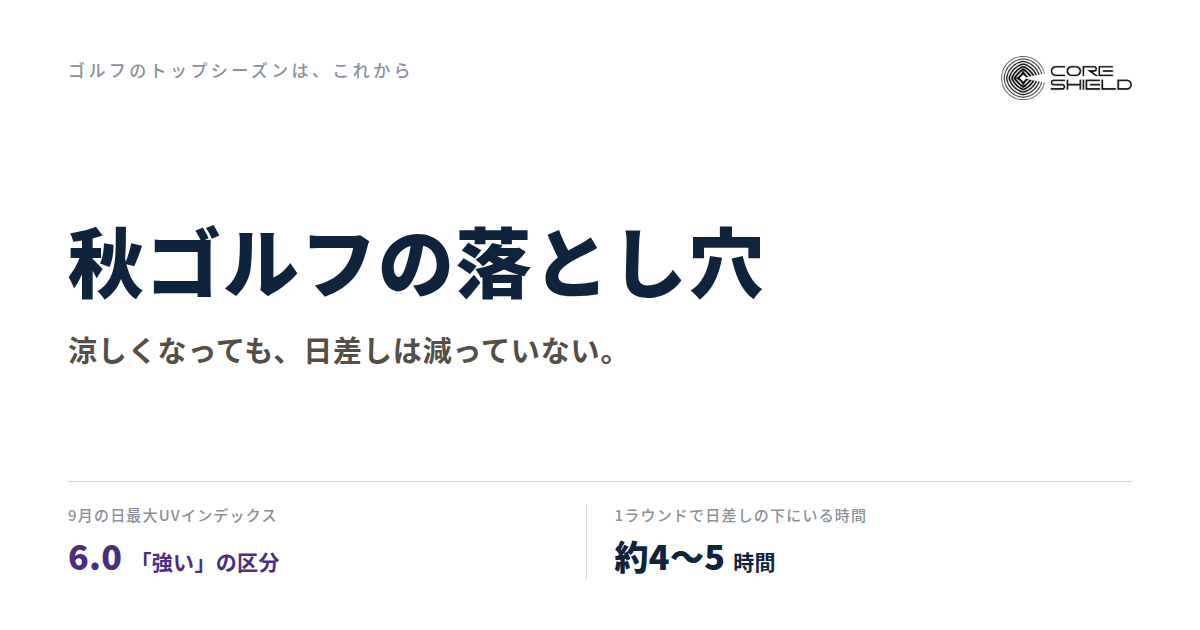
Compared to 7.7 in August, September is at 6.0. While the number has dropped, the classification remains "high." Even though it feels completely different from mid-summer, it remains in the same category in terms of ultraviolet radiation—this is where autumn complacency begins.
Beyond October: UV Rays Drop, but Near-Infrared Rays Decline Much More Slowly
In October, the UV index drops to 3.4. Looking only at this, you might think you no longer need protection. However, sunlight consists of more than just ultraviolet rays.
When calculating how ultraviolet and near-infrared rays decrease in relation to changes in the sun's altitude, the results are as follows:
| Period | UV Rays | Near-Infrared Rays |
|---|---|---|
| August 15 | 100 | 100 |
| September 15 | 89 | 91 |
| October 15 | 74 | 79 |
| November 15 | 58 | 66 |
Calculated values assuming a clear sky at solar noon in Fukuoka (33.6°N latitude). Values are indexed with August 15 as 100.
While UV rays decrease faster, the difference is slight. The important fact is that even in October and November—the best season—60% to 80% of the near-infrared rays from mid-summer remain.
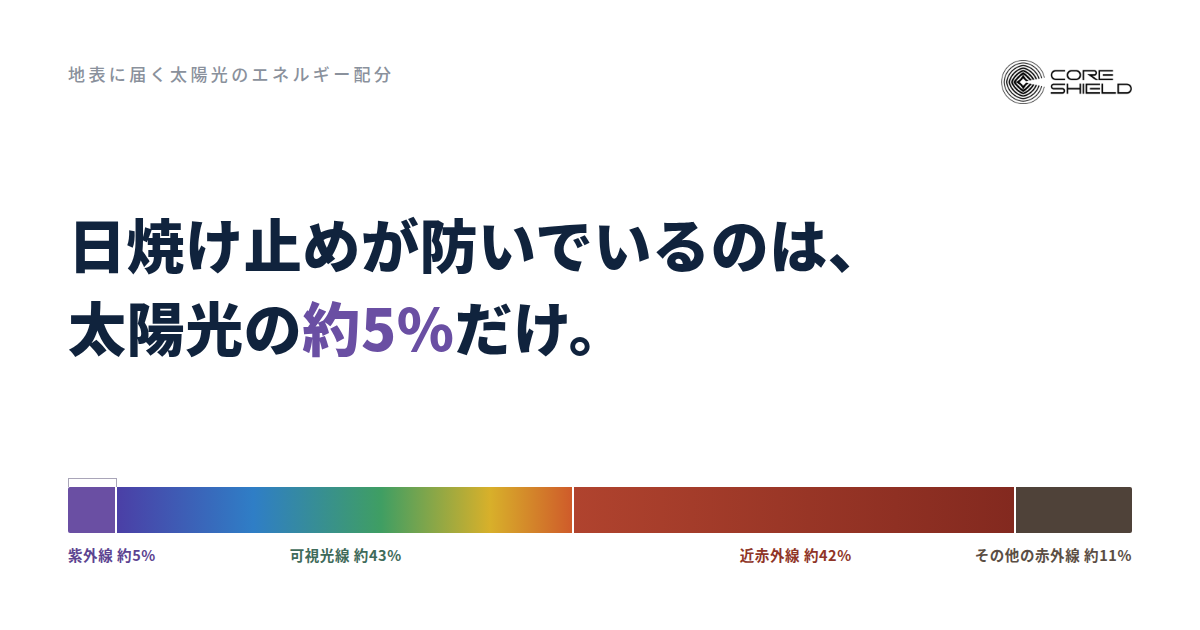
Near-infrared rays account for approximately 42% of the sunlight energy (wavelength 700–1400 nm) that reaches the earth's surface. Because their wavelength is longer than UV rays, they are known to penetrate deeper into the skin, reaching beyond the dermis into subcutaneous tissue and fascia. For more details, please see What is Near-Infrared? Differences from UV Rays and Impact on Heat Stroke and Skin.
There Is No Escape on the Course
The problem is not just the intensity of the light, but the duration of exposure.
A round of golf lasts about 4 to 5 hours. During that time, there is almost no shade on the fairways or greens. In an office or at home, you can avoid the sun, but you cannot do that on the course. A round of golf is the time you spend standing under the sun for the longest continuous period throughout the year.
Additionally, behavior changes in autumn. In mid-summer, everyone starts by applying sunscreen, but as it gets cooler, fewer people do. Even if you do apply it, there is another issue:


The Ministry of the Environment recommends reapplying sunscreen every 2 to 3 hours, as it wears off due to sweat and contact with clothing. For a 4 to 5-hour round, this means you need to reapply at least once during the game. How many people actually do this during their half-time break?
What Are Your Autumn Clothes Actually Protecting?
There is another factor unique to autumn: as it cools down, clothes get thinner.
People who wore long-sleeved innerwear to block the sun in mid-summer often go back to just a short-sleeved polo shirt in September and October. The more comfortable the climate becomes, the more skin is exposed. Your arms, the back of your neck, and around your ears—areas that face the sun with every swing—remain defenseless.
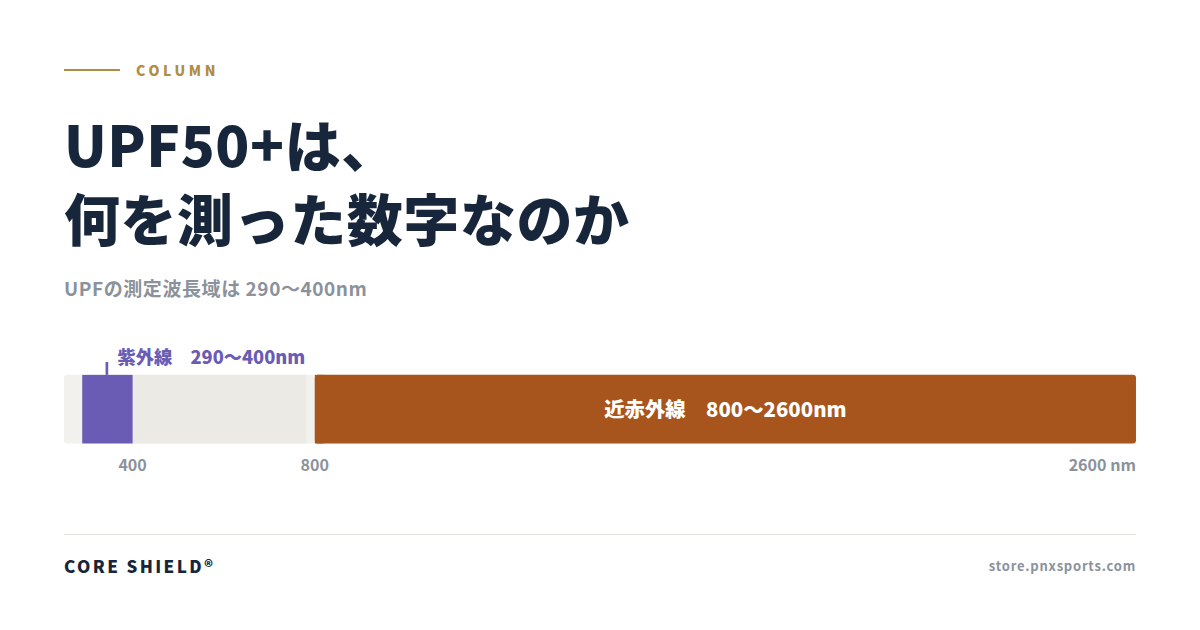
When choosing sportswear, try to check if the near-infrared blocking rate is indicated numerically, rather than just looking for a "UV cut" label. A UPF rating is a coefficient for UV protection and says nothing about infrared rays. This point is explained in detail in What Percentage of Sunlight Does Sunscreen Block?
CORE SHIELD® for Your Autumn Round
CORE SHIELD® is a Japanese apparel brand focused on near-infrared rays. Using specialized Trubeaute® fibers containing CWO® (near-infrared absorbing particles) developed by Sumitomo Metal Mining Co., Ltd., it blocks over 76% of near-infrared rays and over 99% of UV rays (UPF 50+) (all values are based on fabric testing). Because the functional ingredients are kneaded into the fibers, they will not wash off with sweat, and there is no need for reapplication.
You can choose from two long-sleeved innerwear fits:
- Long-Sleeve Mock Neck Innerwear Men's (Slim Fit) — A form-fitting feel. Sleeves reach to the wrist.
- Long-Sleeve Innerwear Men's 2026 Model (Relaxed Fit) — A comfortable, looser fit. Sleeves extend to the back of the hand.
The materials and functions are exactly the same; the difference is only in the fit and sleeve length. If you are layering under a polo shirt, the slim fit is great, and if you dislike the feeling of constriction, the relaxed fit is easy to choose. Please also take a look at our bucket hat, which covers you from your head down to your neck.
Summary
- Spring and autumn are the best seasons for golfers, accounting for about 88%. Autumn is the time when you stand under the sun for the longest time of the year.
- The UV index in September is 6.0, which falls into the same "high" category as August.
- Even in October and November, 60% to 80% of mid-summer near-infrared rays remain.
- A round takes 4 to 5 hours, and there is no shade on the course. Sunscreen requires reapplication during the round.
- As it gets cooler, we wear less clothing, actually reducing the area that is protected.
Autumn is the season when golf is most enjoyable. Precisely for that reason, it is also the season when you spend the most time under the light.
※ UV index values are based on the Japan Meteorological Agency's "Monthly Average of Maximum Daily UV Index (Observed Value)" for Tsukuba in 2025. While values vary by location, the trend of seasonal change remains consistent.
※ Monthly indices for UV and near-infrared rays are spectral calculated values assuming a clear sky at solar noon in Fukuoka (33.6°N). Actual solar radiation varies by weather and time.
※ The survey on the "best season" is based on an ALBA Net questionnaire of 544 amateur golfers (conducted in May 2020).
※ Statements regarding sunscreen reapplication are based on the Ministry of the Environment's "Ultraviolet Environmental Health Manual 2020."
※ Research on the relationship between near-infrared rays and photo-aging (wrinkles/sagging) is currently ongoing and not yet an established conclusion.
※ CORE SHIELD® is clothing and is not intended to prevent or improve blemishes, wrinkles, or sagging.