
Article: What is near-infrared light? An easy-to-understand guide to the differences from ultraviolet rays and their effects on heatstroke and the skin

What is near-infrared light? An easy-to-understand guide to the differences from ultraviolet rays and their effects on heatstroke and the skin
When it comes to staying cool in the summer, many people think of "UV protection." However, in reality, ultraviolet (UV) rays make up only a small fraction of sunlight. The main culprit that raises body temperature and triggers heatstroke is "Near-Infrared (NIR) radiation." In this article, we explain what near-infrared is, how it differs from UV, and how you should protect yourself against it.
What is Near-Infrared?
Near-Infrared (NIR) is a type of invisible light contained in sunlight, accounting for approximately 42% of the solar energy that reaches the Earth's surface. Its wavelength is roughly 700nm to 1400nm, which is longer than visible light. Its most significant characteristic is that it is believed to reach not just the skin's surface, but deep into the subcutaneous tissue.
The breakdown of solar energy reaching the Earth's surface is roughly as follows:
- Ultraviolet (UV / 280–400nm): approx. 5%
- Visible light (400–700nm): approx. 43%
- Near-infrared (700–1400nm): approx. 42%
- Other infrared (1400–4000nm): approx. 11%


Values calculated by integrating the ASTM G173-03 reference solar spectrum (AM1.5 global solar radiation/Earth's surface) by wavelength range. Totals may not equal 100% due to rounding.
In other words, the majority of the heat energy that makes you feel a "scorching" sensation when out in the sun comes not from UV rays, but from infrared radiation—specifically, near-infrared.
Differences Between UV and Near-Infrared
In short: UV is "light that damages the skin surface," while Near-Infrared is "light that delivers heat deep into the body."
| Ultraviolet (UV) | Near-Infrared (NIR) | |
|---|---|---|
| Wavelength range | 280–400nm | 700–1400nm |
| Percentage of sunlight | Approx. 5% | Approx. 42% |
| Depth of penetration | Mainly skin surface to dermis | Believed to reach subcutaneous tissue |
| Primary effects | Sunburn and dark spots | Body temperature rise. Also cited as a cause of sagging |
| Common countermeasures | Sunscreen and UPF materials | Countermeasures are not widespread |
What is important is that typical UV-cut products (sunscreens and UPF-rated apparel) are not designed to block near-infrared radiation. If you feel like your energy is being drained by the heat despite being fully protected from UV rays, it is because your body remains exposed to near-infrared rays.
We explain in detail what range SPF, PA, and UPF ratings actually cover in our article: What percentage of sunlight does sunscreen actually block?
The Mechanism by Which Near-Infrared Causes Heatstroke
Near-infrared penetrates deep into the skin, turns into heat, and directly pushes up the body's internal temperature—or "core body temperature." This is what triggers heatstroke.
Heatstroke occurs when the core body temperature (the temperature of the brain and internal organs) rises, and the body's thermoregulatory function can no longer keep up. When the core temperature exceeds 38°C (100.4°F), symptoms such as dizziness and headaches appear; when it exceeds 40°C (104°F), it can lead to life-threatening conditions like heatstroke (sunstroke) involving loss of consciousness.
The troublesome part is that once your core body temperature rises, it cannot be lowered rapidly. Even if you cool your skin surface with ice or cooling products, the heat trapped in the body's core does not dissipate immediately. That is precisely why the most rational defense against heatstroke is not to "cool it down after it rises," but to "prevent it from rising in the first place" by not allowing near-infrared radiation to reach your body.
*For information on heatstroke symptoms and emergency treatment, please also check the Ministry of the Environment's "Heatstroke Prevention Information Site."
Near-Infrared Can Also Cause Skin Aging
Near-infrared is also known as "aging light," and recent studies have pointed to it as a contributor to wrinkles and sagging. While UV rays cause dark spots and sunburn on the skin's surface, near-infrared is thought to act on deeper layers of the skin, damaging the tissue that supports skin firmness. Note, however, that research into the relationship between near-infrared and photoaging is still ongoing.
Furthermore, unlike UV, the intensity of near-infrared does not decrease much by season; it is present even in autumn and winter. An important point regarding near-infrared protection is that it is not just a "summer-only" issue.
Effective Countermeasures Against Near-Infrared
In conclusion, the basis of near-infrared protection is to "cover your skin with materials that have near-infrared-cutting capabilities." Specifically, keep the following three points in mind:
- Wear apparel made from near-infrared-blocking materials — Regular UV-cut clothing cannot block near-infrared rays. Look for products that specify a numerical "near-infrared cut rate."
- Prioritize protecting your core (torso) — The primary factor raising core body temperature is the accumulation of heat in the torso. It is more efficient to protect your torso from near-infrared rays before focusing on your arms or legs.
- Protect yourself year-round — Since near-infrared intensity remains relatively high through autumn and winter, it is ideal to use it as a year-round measure, not only for summer heatstroke prevention but also for anti-aging skin care.
CORE SHIELD®, Which Blocks Over 76% of Near-Infrared
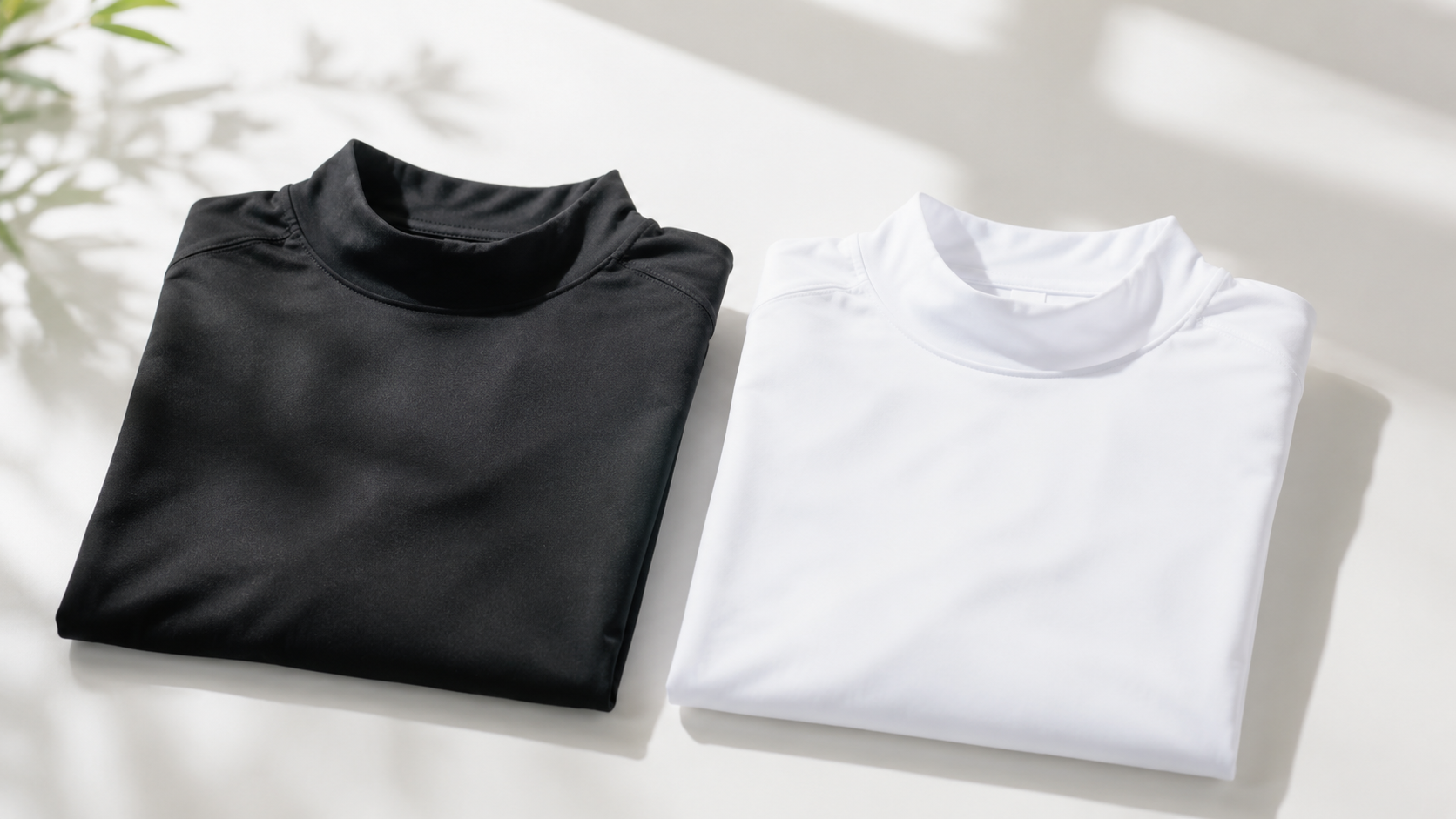
CORE SHIELD®, available at our store, is a Japanese-made heatstroke-prevention apparel brand that focuses on this near-infrared radiation. Using Trubeaute®, a special fiber infused with CWO® (near-infrared-absorbing fine particles developed by Sumitomo Metal Mining Co., Ltd.), it blocks over 76% of near-infrared rays (tested as fabric only). Additionally, independent third-party testing has confirmed that wearing long-sleeved innerwear can suppress the rise in temperature inside the garment by up to 2°C (tested as innerwear).
It also features UPF50+ UV protection (tested as fabric only; over 99% blocked), a cool-to-the-touch sensation, and sweat-wicking/quick-drying functions, supporting your outdoor activities—such as golf, field work, farming, or walking—from the core.
Summary
- Near-infrared accounts for approximately 42% of the sunlight reaching the Earth's surface—more than eight times the amount of UV (approx. 5%).
- It is a primary cause of heatstroke, penetrating deep into the skin and raising core body temperature.
- It cannot be blocked by standard UV-cut products; specialized near-infrared-blocking materials are required.
- Because it is present even in autumn and winter, year-round care is effective for anti-aging.
If you feel like "summer is tough even though I take UV precautions," try turning your attention to the 42% you haven't been protecting against: near-infrared radiation.
*The solar composition in this article uses values obtained by integrating the ASTM G173-03 reference solar spectrum (AM1.5 global solar radiation/Earth's surface, 280–4000nm) by wavelength range. Wavelength ranges are defined as: UV 280–400nm, Visible light 400–700nm, Near-infrared 700–1400nm, and Other infrared 1400–4000nm.
*The relationship between near-infrared and photoaging (wrinkles/sagging) is still a subject of ongoing research and is not a settled conclusion.
*CORE SHIELD® is an item of clothing and is not intended to prevent or improve dark spots, wrinkles, or sagging.
%20rays%20make%20up%20only%20a%20small%20fraction%20of%20sunlight.%20The%20main%20culprit%20that%20rais...)