
How to Choose Heatstroke Prevention Innerwear: A Thorough Guide to the Differences Between Cooling and Heat-Shielding Types
Functional innerwear has become a summer necessity. However, many people often say, "I'm wearing cooling innerwear but I'm still hot" or "I don't know which one to choose." In fact, there are two types of innerwear with different mechanisms marketed for heatstroke prevention, and if you choose without knowing the difference, you won't get the expected results. This article explains the mechanism of each and the criteria for choosing the right one.
There are two types of heatstroke prevention innerwear
Heatstroke prevention innerwear can be broadly divided into two types: the "cooling type" and the "heat-shielding type." The former is innerwear designed to "make you feel cool," while the latter is innerwear that "prevents heat from entering the body."
| Cooling Type | Heat-Shielding Type (Near-Infrared Cut) | |
|---|---|---|
| Mechanism | Uses materials that feel cool to the touch (contact cooling) or utilizes evaporative cooling | The fabric blocks near-infrared rays, which cause body temperature to rise |
| Nature of effect | An approach to physical sensation (how it feels) | Suppresses the rise in deep body temperature itself |
| Persistence of effect | Becomes less noticeable as sweat dries or the skin gets used to it | Lasts throughout wear due to fabric functionality |
| Suitable situations | Indoors, shade, short outings | Long-term activities under direct sunlight |
Why you may feel "cooling innerwear doesn't work"
This is because many cooling innerwear products do not lower your body temperature, but rather "make you feel cold."
Contact cooling materials create a "chilly" sensation by quickly drawing heat away from your skin the moment it touches. However, this is only a sensation at the moment of wearing it; under direct sunlight, the heat from the sun (mostly near-infrared rays) continues to reach your body relentlessly. As long as the amount of incoming heat remains the same, your deep body temperature will continue to rise. The fact that "it feels cool the moment I put it on, but I'm ultimately hot under the blazing sun" is not a defect in the product, but rather due to the fundamental mechanism itself.
You can stay comfortable with a cooling type in indoor or air-conditioned environments. The problem is in situations where you are exposed to direct sunlight for long periods, such as golf, fieldwork, or farm work. In these cases, you need a measure that reduces the "incoming heat" rather than just the "sensation," which is where the heat-shielding type comes in.
Mechanism of the heat-shielding type (near-infrared cut)
Heat-shielding innerwear uses fabric to block near-infrared rays, which account for about 42% of sunlight, thereby cutting off the cause of rising body temperature at the source.
Near-infrared rays are a major cause of heatstroke, as they reach deep into the skin, turn into heat, and push up the body's internal temperature (deep body temperature). General UV-cut innerwear (with UPF ratings) is designed to protect against ultraviolet rays (about 8% of sunlight) and cannot block near-infrared rays. For more details on the properties of near-infrared rays, please refer to "What is Near-Infrared? The Difference from UV and Its Impact on Heatstroke and Skin."
When choosing a heat-shielding type, please be sure to check whether the "near-infrared cut rate" is indicated along with a numerical value and the name of the testing institution. For products merely labeled "heat-shielding" or "cool," the actual cutting performance is unknown.
3 criteria for choosing
Criterion 1: Choose based on the situation of use. A cooling type is sufficient for indoors or short outings. If you will be active under direct sunlight for an hour or more, choose a heat-shielding type. If a product features both (near-infrared cut + contact cooling), you can use it regardless of the situation.
Criterion 2: Choose based on whether there is evidence for the figures. Products where figures like "near-infrared cut rate of X%" or "suppresses garment internal temperature by X°C" are presented as results from third-party testing organizations are reliable. Distinguish them from products that only use conceptual imagery.
Criterion 3: Choose based on the durability of the effect. If the function relies on surface treatment of the fabric, the effect may diminish with repeated washing. Types where the functional ingredients are kneaded into the fibers themselves will maintain their effect semi-permanently even after washing. Consider whether you are buying for a single season or intend to use it for a long time.
Recommendations by situation
- Golf: Since you are exposed to direct sunlight for 4–5 hours during play, the heat-shielding type is the first choice. A sleeveless style is comfortable when worn under a polo shirt. Overall measures for summer rounds are summarized in "Summary of Heatstroke Countermeasures for Golf."
- Fieldwork/Farm work: For long hours and high-intensity labor, deep body temperature control is the top priority. Using heat-shielding innerwear in combination with fan-equipped clothing is an excellent pairing, as it also suppresses the rise in temperature of the air delivered by the fan.
- Commuting/Walking/Shopping: If you are outdoors for less than 30 minutes, a cooling type is acceptable. This can be covered by using a parasol or hat. Measures for commuting and walking in urban areas are explained in detail in "Why are cities dangerous in summer?"
-
Outdoor sports spectating/Events: Since you will be sitting under the blazing sun for several hours, use a heat-shielding type plus frequent hydration.
"CORE SHIELD®" that blocks over 76% of near-infrared rays
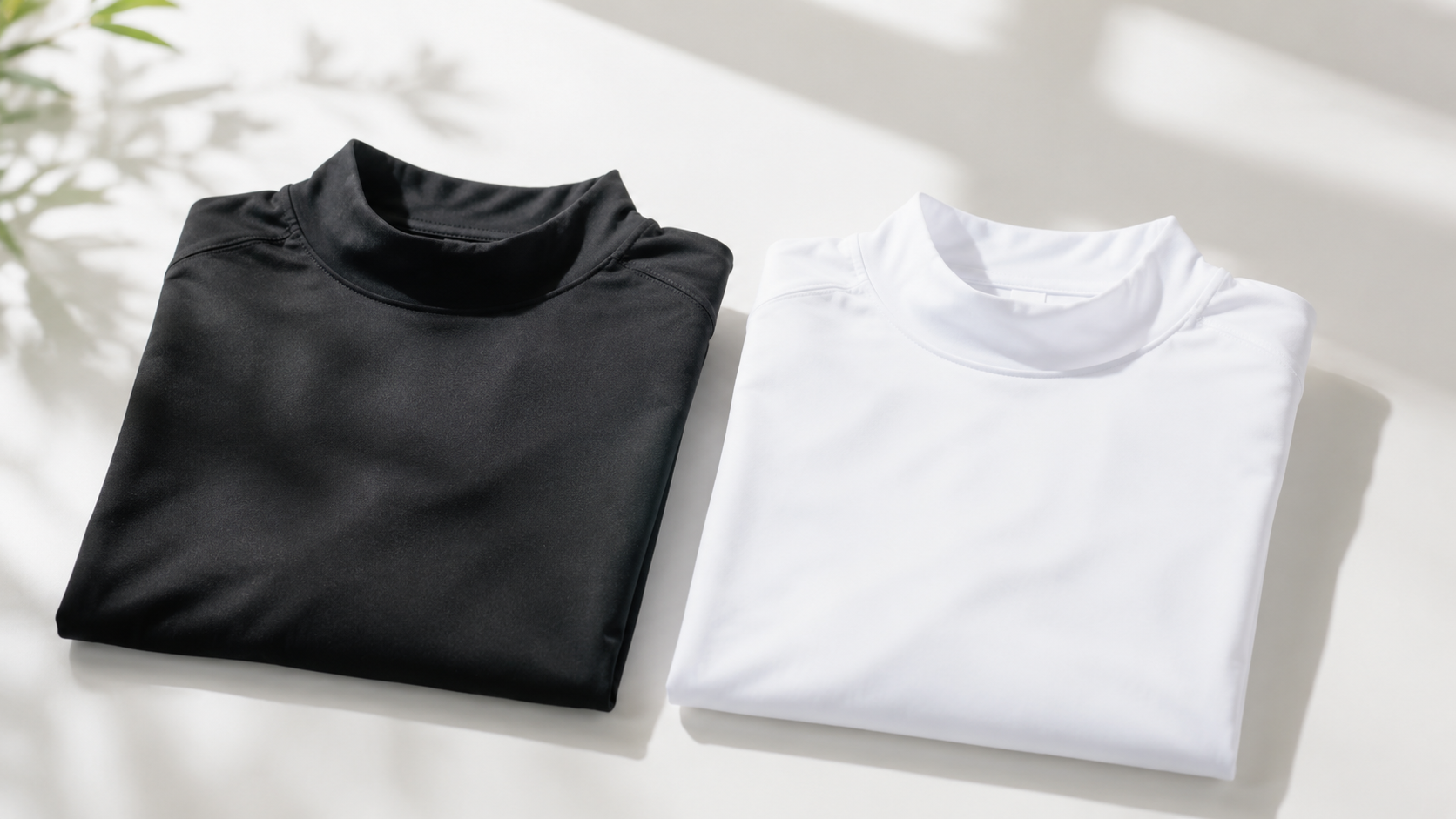
Our store's CORE SHIELD® is a Japanese-made heatstroke prevention innerwear categorized as a heat-shielding type. It uses Trubeaute®, a special fiber containing CWO®, a near-infrared absorbing microparticle developed by Sumitomo Metal Mining Co., Ltd. Tests by a third-party organization have confirmed that it blocks over 76% of near-infrared rays and suppresses the rise in garment internal temperature by up to 2°C during wear (*please refer to the product page for details on testing conditions).
Because the functional ingredients are kneaded into the fibers, the effect lasts even after washing, and it also features contact cooling, sweat absorption/quick-drying, and UPF50+ performance. This is one piece of gear we especially want those who have felt unsatisfied with "cooling innerwear" to try and experience the difference.
Summary
- Heatstroke prevention innerwear differs in mechanism between "cooling type" and "heat-shielding type."
- Cooling types are an approach to physical sensation. They cannot prevent heat intrusion under direct sunlight.
- For long-term activity under direct sunlight, use a heat-shielding type that blocks near-infrared rays.
- The criteria for choosing are: "situation," "numerical evidence," and "persistence of effect."
Choose the type that suits your needs and stay safe this summer.