What percentage of sunlight does sunscreen block?
Have you ever wondered how much of the sunlight you are actually blocking on the days you head out wearing sunscreen? The answer is about 5%. In this article, we will break down the range covered by sunscreen and UV-protection clothing, as well as the remaining parts that are not.
Sunscreen only covers about 5% of sunlight
First, let's look at the breakdown of solar energy reaching the earth's surface.
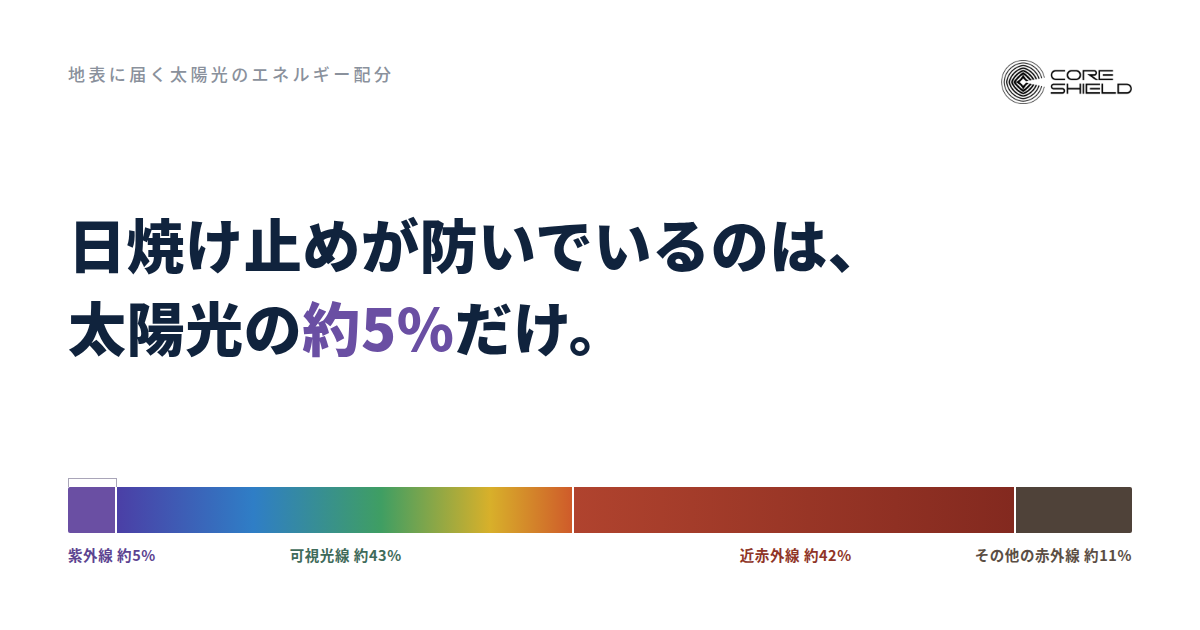
- Ultraviolet (UV / 280–400nm): About 5%
- Visible light (400–700nm): About 43%
- Near-infrared (700–1400nm): About 42%
- Other infrared (1400–4000nm): About 11%


Values obtained by integrating the ASTM G173-03 reference solar spectral irradiance (AM1.5 global tilt/surface) by wavelength range. Totals do not equal 100% due to rounding.
Sunscreen is designed specifically to block this ultraviolet portion. It is the thin band on the far left of the bar graph, accounting for about 5% of the total.
To avoid any misunderstanding, this is not a flaw in sunscreen. Sunscreen is a product made to block ultraviolet rays, and it fulfills that role properly. The problem lies in our tendency to think that "wearing sunscreen means I've finished my sun protection."
SPF, PA, and UPF: All three metrics relate only to ultraviolet rays
Lining up the figures written on sun protection products makes this structure clear.
| Rating | What it evaluates | Target Light |
|---|---|---|
| SPF | A metric primarily for blocking UV-B. Indicates how many times longer it takes for skin to redden from sunburn. | Ultraviolet |
| PA | A metric for blocking UV-A. Divided into 4 levels based on the number of + signs. | Ultraviolet |
| UPF | A protection factor indicating how much UV radiation clothing blocks. | Ultraviolet |
The definitions of SPF and PA are also stated in the Ministry of the Environment's "2020 Ultraviolet Environment Health Manual."
In other words, even if you wear sunscreen rated SPF50+ and PA++++ while wearing UPF50+ clothing, you are only protected within that 5% range of sunlight. While higher numbers can make you feel "completely protected," those numbers are only measuring ultraviolet rays.
What is contained in the remaining 95%?
Returning to the breakdown: about 43% is visible light, and about 42% is near-infrared.
Near-infrared is invisible light with a wavelength of approximately 700–1400nm. Because its wavelength is longer than that of ultraviolet rays, it is pointed out that it reaches deep into the skin, past the dermis and into the subcutaneous tissue and fascia. Much of the "scorching heat" sensation felt when exposed to sunlight is caused by this near-infrared light, not ultraviolet.
For more details on near-infrared rays, please refer to: What is Near-Infrared? Differences from Ultraviolet and Impact on Heatstroke/Skin.
There is another limitation to "topical" protection
In addition to the narrow range of protection, even that narrow range cannot be maintained if you just apply it once.
The Ministry of the Environment's manual recommends reapplying sunscreen every 2 to 3 hours. The reason is that sunscreen wears off through contact with hands or clothing, perspiration, and wiping with towels or handkerchiefs.
Try applying this "2 to 3 hours" figure to your actual time spent outdoors.
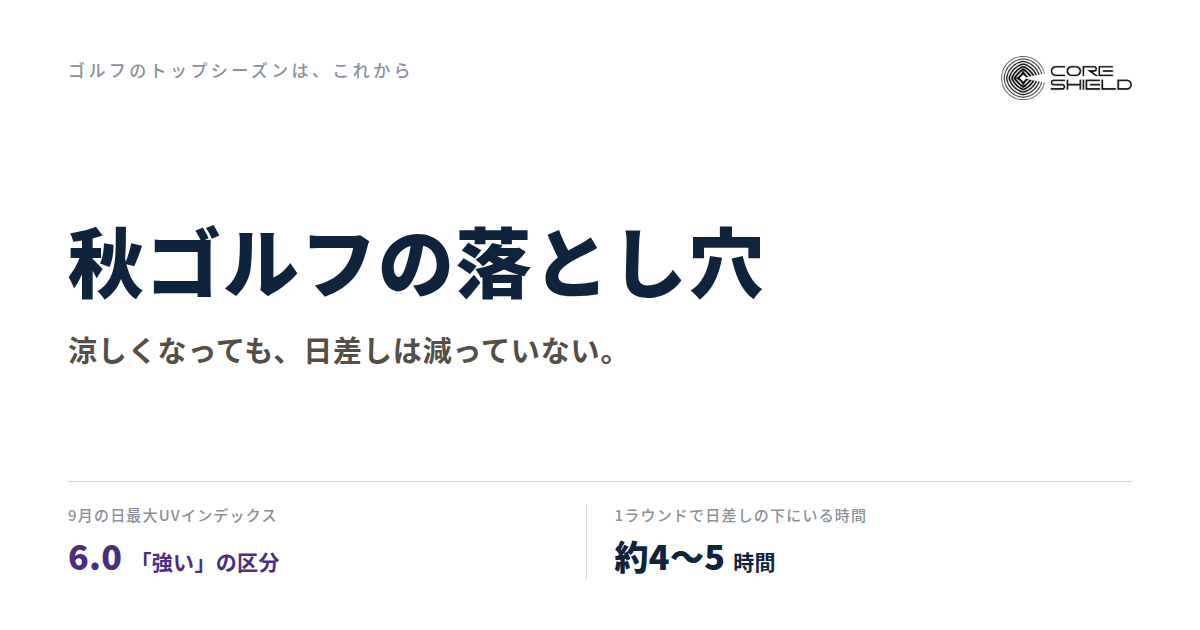
- One round of golf: About 4–5 hours. This means at least one reapplication is required midway through.
- Gardening or farm work: Twice for half a day, or three or more times from morning until evening.
- On-site labor: Can you really reapply on time when your hands are dirty?


Sunscreen wears off more easily in seasons when you sweat, which is precisely when reapplication becomes impractical. While it makes sense as a measure, it is hard to keep up. This is the structural problem with the "topical" method.
The idea of reducing the light itself
Summarizing everything so far, we know that two things are necessary:
- Protection against not only ultraviolet but also near-infrared light.
- A method that does not rely on reapplication and lasts as long as you wear it.
The way to satisfy both at the same time is to cover your skin with material that has near-infrared blocking functionality. When choosing clothing, check not only for a "UV cut" label but also to see if the near-infrared blocking rate is indicated numerically. Products without this information may not have been created with near-infrared protection in mind.
CORE SHIELD®: Blocking over 76% of near-infrared light
Available in our store, CORE SHIELD® is a Japanese clothing brand focused specifically on this near-infrared light. Through its special fiber, Trubeaute®, which incorporates CWO® near-infrared absorbing particles developed by Sumitomo Metal Mining Co., Ltd., it blocks over 76% of near-infrared light (test values based on the fabric alone). It also blocks over 99% of ultraviolet rays and is rated UPF50+ (also test values based on fabric alone).
Because the functional ingredients are kneaded into the fibers, the protection will not wash away with sweat, and there is no need for reapplication. It remains effective until you take it off.
Summary
- Sunscreen is designed to block ultraviolet rays, which account for about 5% of sunlight reaching the ground.
- SPF, PA, and UPF are all ultraviolet metrics; there are no items that evaluate infrared rays.
- About 42% of the remainder is near-infrared light, which is noted for reaching deep into the skin.
- Sunscreen is recommended to be reapplied every 2–3 hours, making it difficult to maintain during long outdoor activities.
- "Covering" rather than "applying" can solve both the range and the duration issues at once.
Sunscreen is an excellent tool for protecting that 5%. The problem is that the other 95% hasn't even been part of the conversation for so long.
※ The solar composition in this article is based on the ASTM G173-03 reference solar spectral irradiance (AM1.5 global tilt/surface, 280–4000nm) integrated by wavelength range. Wavelength ranges are defined as: Ultraviolet 280–400nm, Visible light 400–700nm, Near-infrared 700–1400nm, and Other infrared 1400–4000nm.
※ Definitions of SPF/PA and statements regarding sunscreen reapplication are based on the Ministry of the Environment's "2020 Ultraviolet Environment Health Manual."
※ The relationship between near-infrared light and photoaging (wrinkles/sagging) is currently being researched and is not a settled conclusion.
※ CORE SHIELD® is an item of clothing and is not intended to prevent or improve dark spots, wrinkles, or sagging.