Revisiting Mandatory Heatstroke Prevention in the Workplace in Its Second Summer: Beyond Structural Improvements to "Equipment"
In June 2025, the enforcement of the revised Industrial Safety and Health Regulations made heatstroke prevention measures in the workplace a mandatory requirement subject to penalties. As we enter the second year since this enforcement, many workplaces have likely already established their reporting systems and manuals. However, the number of workplace heatstroke incidents continues to rise. This article provides a concise summary of the key points of this mandate and explores the "next step" in establishing a system: how to think about equipment that protects the physical health of every individual on the front lines.
A 3-minute summary of the mandate
Under the revised Industrial Safety and Health Regulations (Article 612-2) effective June 1, 2025, business operators performing work in certain hot environments are required to: (1) establish and communicate a reporting system, and (2) formulate and communicate procedures for measures to prevent health deterioration.
This applies to work that is expected to be performed in environments with a WBGT (Wet Bulb Globe Temperature) of 28°C or higher, or an air temperature of 31°C or higher, for one continuous hour or more, or for more than four hours per day. This includes not only outdoor construction, landscaping, and agricultural work but also indoor work in factories, warehouses, and kitchens where air conditioning is difficult to maintain. There are no exemptions based on industry or company size.
There are two main requirements for business operators:
1. Establishment and Communication of a Reporting System: Each workplace must designate contact points and responsible persons for workers who feel symptoms of heatstroke or anyone who discovers a worker suspected of having heatstroke, and this information must be communicated to all relevant workers.
2. Formulation and Communication of Procedures for Preventing Deterioration: Each workplace must establish and communicate to relevant workers the procedures for when symptoms are suspected, such as "withdrawing from work," "cooling the body," and "seeking medical attention as necessary," as well as emergency contact networks and information on medical facilities for transport.
Failure to implement these measures may result in penalties for violating the Industrial Safety and Health Act (imprisonment of up to 6 months or a fine of up to 500,000 yen), as well as corrective guidance from the Labor Standards Inspection Office and the risk of civil liability for breach of safety obligations.
*Please be sure to check primary sources, such as the Ministry of Health, Labour and Welfare’s "Strengthening Heatstroke Prevention Measures in the Workplace," for the latest and most detailed information on regulations.
Incidents are still rising—2025 saw a record high
In 2025, the first year of the mandate, the number of workplace heatstroke casualties (requiring 4 or more days of leave) reached 1,803, the highest on record (final figures from the Ministry of Health, Labour and Welfare).
Establishing a system is a mechanism to minimize damage "once a heatstroke occurs." While reporting systems and response procedures are essential lifelines, they do not reduce the incidence of heatstroke itself. The rise in casualties highlights the reality that, in the face of intensifying heatwaves, we need to invest in prevention—"preventing it from happening in the first place"—in parallel with systems for "responding after it occurs."
The key to prevention is reducing "heat entering the body"
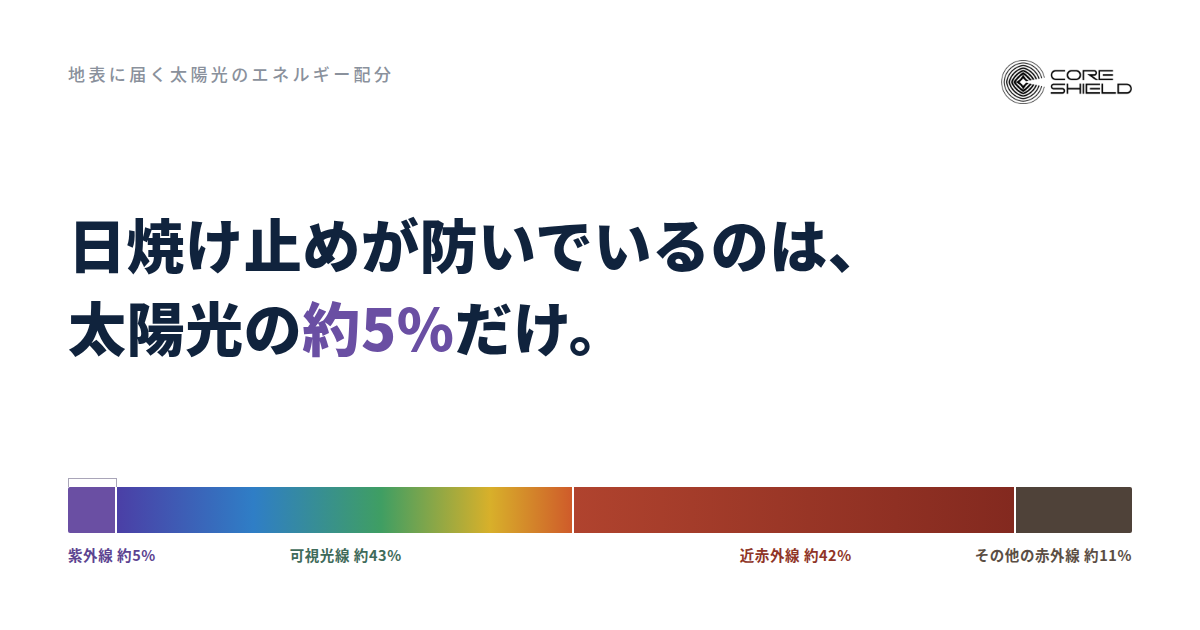
Heatstroke occurs when core body temperature rises and the body's thermoregulation can no longer keep up. The primary component of the heat that drives up core body temperature is near-infrared radiation, which accounts for approximately 42% of sunlight (wavelength range of 700–1400 nm).
Just as WBGT includes "radiant heat" as an evaluation factor, heat entering the body from direct sunlight or reflected heat is a major factor in workplace heat risk. Since near-infrared rays reach deep into the skin and turn into heat, they cannot be blocked by standard UV-cut clothing (for more details, see "What is Near-Infrared?"). Furthermore, since core body temperature is not easily lowered once it rises, measures to "prevent it from rising" are structurally advantageous (see "What is Core Body Temperature?").
The optimal solution for workplace equipment: A two-pronged approach of "blocking" and "venting"
If fan-equipped workwear is equipment that "vents heat," then heat-shielding innerwear is equipment that "prevents heat from entering." Because their roles differ, using them together compensates for each other's weaknesses.
Fan-equipped workwear uses a fan to evaporate sweat with outside air; therefore, its cooling efficiency drops on extremely hot days when the outside temperature nears body temperature. Moreover, near-infrared rays from direct sunlight continue to penetrate the garment and heat the body. By combining this with heat-shielding innerwear that cuts near-infrared rays on the skin side, the heat entering the torso is reduced, making it easier for the cooling effect of the fan-equipped clothing to "keep up." Additionally, adding a heat-shielding hat to protect the head completes a setup that covers the two main entry points for heat (the head and the torso).
Details on the selection and operation of workplace equipment are also explained in "Heat protection for fieldwork and agricultural work."
CORE SHIELD®: Chosen as equipment for employees
Our store's CORE SHIELD® is a heatstroke-prevention garment made in Japan that serves as preventative equipment to "stop heat from entering the body." Using Trubeaute®, a special fiber embedded with CWO® (near-infrared absorbing fine particles) developed by Sumitomo Metal Mining Co., Ltd., it cuts over 76% of near-infrared rays. Tests by a third-party testing organization have confirmed that the inner shirt suppresses the rise in temperature inside the garment by up to 2°C during wear (please see the product page for details on test conditions).
Because the functional components are embedded within the fibers, the effect is semi-permanently sustained even with daily washing. The fact that it is "long-lasting" as provided equipment is one of the reasons it is adopted by corporations.
For bulk orders by corporations or organizations, and inquiries regarding invoicing, please visit our Corporate Inquiry page.
Summary
- As of June 2025, workplace heatstroke prevention measures (establishing and communicating reporting systems and deterioration prevention procedures) are mandatory and subject to penalties.
- This applies to work at a WBGT of 28°C or higher, or an air temperature of 31°C or higher, for more than 1 continuous hour or more than 4 hours per day. Indoor work may also be covered.
- Even after the mandate, workplace heatstroke casualties have increased, reaching a record high of 1,803 in 2025.
- In addition to system development (responding after an incident occurs), invest in "preventative equipment" to reduce the occurrence itself.
- A two-pronged approach—"blocking heat with shielding innerwear" × "venting heat with fan-equipped workwear"—is logical.
The safety of workers is the foundation that supports not only legal compliance but also on-site productivity and corporate trust. As we face our second summer, please review your on-site "equipment" alongside your system checks.