Why are summers in the city dangerous? Heatstroke prevention for urban heat islands and reflected heat
"Have you ever noticed that when you return to your family home in the suburbs, the same temperature feels much more comfortable?" This isn't just your imagination. Summers in the city are different from those in the suburbs. Moreover, urban heat has a unique and troublesome characteristic: "heat coming from below and from the sides" that parasols and hats alone cannot prevent. This article explains heatstroke prevention measures for those who live and work in urban areas.
Why cities are hotter than the suburbs: The "Heat Island Effect"
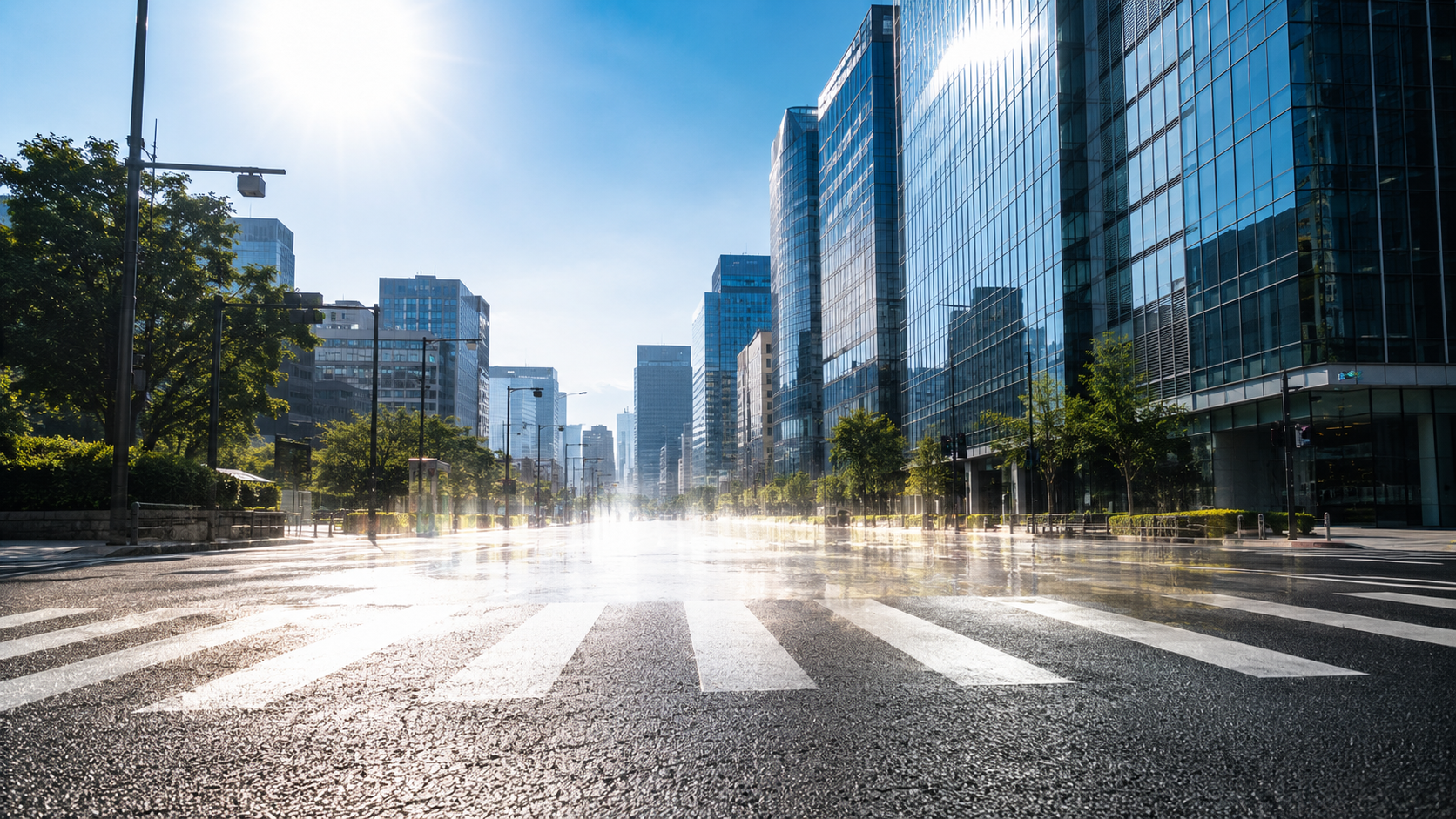
The phenomenon where temperatures in the center of a city are higher than in the suburbs is called the "Heat Island Effect." The main cause is the asphalt and concrete covering the ground surface, which absorb heat during the day and continue to release it.
Soil and greenery dissipate heat through the evaporation of water. Conversely, asphalt and concrete contain no moisture, so cooling through evaporation does not occur; instead, they store the energy of sunlight—particularly near-infrared radiation, which accounts for about 42% of sunlight—directly. Added to this is the exhaust heat from air conditioner outdoor units and cars, turning the entire city into an "island that stores heat."
On a sunny midsummer day, the surface temperature of asphalt can reach 50–60°C, far exceeding the air temperature. Urban sidewalks are, in a sense, giant heat-storage plates.
Urban-specific risk ①: "Heat from below" — Reflection
Even if you block direct sunlight from above with a hat or parasol, the reflection (re-radiation) from the heated road surface continues to heat your body from below.
This reflection includes both sunlight (including near-infrared) bounced off the road surface and the heat emitted by the road surface itself, which has stored the heat. Your face, neck, and the lower half of your torso are almost entirely defenseless against this "heat from below." The reason children in strollers and small dogs are said to be in greater danger than adults is that they are exposed to this heat more intensely the closer they are to the ground.
"Why do I feel so exhausted even though I'm using a parasol?" Part of the reason lies in the heat from below and from the sides that you aren't blocking.
Urban-specific risk ②: Temperatures that don't drop at night and "accumulated heat fatigue"
Another feature of urban heat is that temperatures remain high even at night.
The heat stored in buildings and roads during the day continues to be released slowly even after sunset. When tropical nights persist, the body cannot recover during sleep, and fatigue and heat stress accumulate day after day. This daily accumulation is the background behind many urban heatstroke cases where people "collapsed even though it wasn't an exceptionally hot day." The risks of starting the next day without your internal body temperature (core body temperature) fully dropping are explained in detail in "What is core body temperature?"
Urban heat countermeasures for commuting and walking
The philosophy for dealing with urban heat consists of three approaches: "reduce the heat you take in," "don't store it in your body," and "ensure recovery."
1. Choose your route and time Even for the same distance, the amount of heat you take in is completely different between sunny asphalt and the shade of buildings, underground malls, or arcades. It is worth taking a few minutes to walk a detour to choose a shaded route. If possible, go out in the morning before the road surface has finished storing heat.
2. Wear clothing that considers heat "from above and below" It is basic to block direct sunlight from above with a hat or parasol. In addition to this, for heat from all directions, including reflections, it is reasonable to cover your torso with a near-infrared cutting material. Please note that standard UV-cut apparel is for protection against ultraviolet rays (about 8% of sunlight) and cannot block near-infrared rays, which are the main component of heat (for details, see "What is near-infrared? Differences from UV" and "How to choose heatstroke prevention innerwear").
3. Hydrate and take in salt "before you move" Don't wait until you arrive at the station; take a sip before you start walking. Urban travel often involves a pattern of "walking for 10 minutes, cooling down on a train, and walking for another 10 minutes," which causes drastic fluctuations in heat exposure; frequent replenishment reduces the burden on your body's temperature regulation.
4. "Reset" with your sleep environment In cities with tropical nights, controlling the temperature of your bedroom dictates your risk of heatstroke the following day. Not skimping on air conditioning and allowing your body to recover until morning is a vital heatstroke countermeasure.
Near-infrared cutting innerwear effective against "heat from above and below"
Our store's CORE SHIELD® is a Japanese-made innerwear for heatstroke prevention that addresses near-infrared radiation, the main component of heat coming from all directions in the city. Using Trubeaute®, a special fiber containing CWO®, a near-infrared absorbing fine particle developed by Sumitomo Metal Mining Co., Ltd., it cuts near-infrared rays by over 76% and is confirmed by a third-party testing agency to suppress the rise in temperature inside the clothing during wear by up to 2°C (please check the product page for details on test conditions).
Because it covers your torso as an inner layer, it is well-suited for city life as it works not only against direct sunlight but also against reflections and side heat that parasols and hats cannot cover. For commuting and outings, its contact-cooling and sweat-wicking properties, which suppress the stickiness of sweat, also contribute to your comfort.
Summary
- Cities are hotter than the suburbs due to heat storage in asphalt/concrete (Heat Island Effect)
- Hats and parasols cannot block reflection from the road = "heat from below"
- Temperatures that don't drop at night cause daily accumulation of heat fatigue
- Countermeasures are: "shaded routes/times," "clothing effective against heat from above and below," "hydration before moving," and "recovery through sleep"
- For near-infrared (the main component of omnidirectional heat), a near-infrared cutting inner layer covering the torso is logical
Summer in the city puts more stress on your body than the "today's maximum temperature" figure suggests. Understand the structure of the city and survive the summer wisely.