
Why Hats Are Essential for Heatstroke Prevention: How to Choose One and the New Standard of "Near-Infrared Cut"
As a measure against heatstroke, a hat is not just "nice to have," it is "essential." However, not all hats are equally effective. In fact, if you choose the wrong one, you may find yourself feeling hot despite wearing it, or experiencing discomfort due to stuffiness. In this article, we will explain why hats are effective for heatstroke prevention and introduce a new selection criterion to look for alongside shade and breathability: "near-infrared ray protection."
Why head protection is crucial
The head is the part of the body exposed to direct sunlight for the longest duration and at the closest angle to perpendicular.
The midsummer sun beats down from high overhead. While the amount of solar radiation received by the sides of the body changes depending on the angle relative to the sun, the crown of the head faces the sun directly throughout the day. Furthermore, the head is close to the brain, and heat trapped in the hair and scalp leads directly to intense discomfort and feelings of lightheadedness. Being outdoors in the blazing sun without a hat is the same as leaving the command center of your body defenseless against heat.
The main component of solar heat is near-infrared radiation, which accounts for approximately 42% of sunlight. It penetrates deep into the skin, turns into heat, and raises the body's internal temperature (core body temperature), making it a primary factor in heatstroke (for more details, see "What is Near-Infrared? Differences from UV rays and effects on heatstroke and skin"). The essential role of a hat is to block this entry point for heat overhead.
Is it true that "black hats are hot"?
It is half-true and half-misconception. What matters more than the surface color is "whether the fabric lets heat through to the inside" and "whether it can release trapped heat."
It is true that black absorbs light more easily, so the surface temperature of a black hat tends to be higher than a white one. However, what matters to the wearer is not the surface temperature, but the amount of heat reaching the head. If the fabric allows sunlight (especially near-infrared rays) to pass through to the inside, the head will heat up regardless of the color. Conversely, if the fabric itself can block near-infrared rays, the difference due to surface color becomes minimal. Furthermore, a structure that allows internal heat to escape, such as through ventilation holes, can prevent heat buildup.
In other words, it is rational to choose a hat based on "whether the fabric transmits heat" and "whether it can release heat," rather than whether it is white or black.
Four criteria for choosing a hat for heatstroke prevention
Choose based on these four criteria: "brim width," "breathability," "near-infrared protection," and "fit/chin strap."
1. Brim Width: Caps (brim only in the front) are excellent for visibility, but leave the neck, ears, and sides of the face unprotected. A hat type with a full-circle brim can block direct sunlight not just from the head, but from the neck area as well. The longer you spend under the blazing sun, the more advantageous a full-brimmed hat becomes.
2. Breathability: No matter how well a hat blocks the sun, if heat and humidity are trapped inside, it will be uncomfortable and cause a sweaty scalp. Check for ventilation holes, the use of mesh materials, and linings that wick sweat and dry quickly.
3. Near-Infrared Protection (New Criterion): Typical "UV protection" labeling on hats refers to ultraviolet rays (approx. 8% of sunlight) and does not account for near-infrared rays (approx. 42%), which are the main cause of rising body temperature. If the hat fabric itself blocks near-infrared rays, you can reduce the heat entering the head at the source. When choosing, check if the "near-infrared cut rate" is indicated as a specific value.
4. Fit and Chin Strap: Golf courses and work sites are often windy, and if a hat blows off, you will eventually stop wearing it. Size adjustment features and the presence of a chin strap are practical points that determine whether you can use the hat every day.
Choosing a hat by scene
- Golf: A full-brimmed hat is best for 4-5 hours of direct sunlight. Prioritize light weight and quick-drying linings so you can focus on your game even if you sweat (for overall round strategies, see "Golf Heatstroke Prevention Summary").
- Field Work: If wearing a helmet, use an inner cap type; for work where a helmet is unnecessary, use a wide-brimmed hat. Prioritize compliance with safety standards above all else.
- Farm Work: Since you are often leaning forward, the brim width and depth of the shade covering the back of your neck are important. A chin strap is essentially mandatory.
- Walking/Daily Life: Since you wear it every day, prioritize lightness, washability, and a design that is easy to match with clothes. A "hat you want to wear" is ultimately the best heatstroke prevention.
Protect yourself with a "top and bottom set" of hat and innerwear
A hat blocks heat entering the head, and thermal innerwear blocks heat entering the torso—blocking these two major heat entry points from top to bottom is the most rational equipment under direct sunlight.
The entry points for heat that raise core body temperature are the head and the trunk (torso). Protecting only one will leave you vulnerable to heat through the other. By combining a near-infrared cutting hat with innerwear, you complete a "reduce incoming heat" strategy for the entire body (see "How to Choose Heatstroke Prevention Innerwear" for selection guidance).
Near-infrared cutting fabric hats now available from CORE SHIELD®
CORE SHIELD®, whose heatstroke prevention innerwear is loved by many, is launching new hats using the same near-infrared cutting fabric.
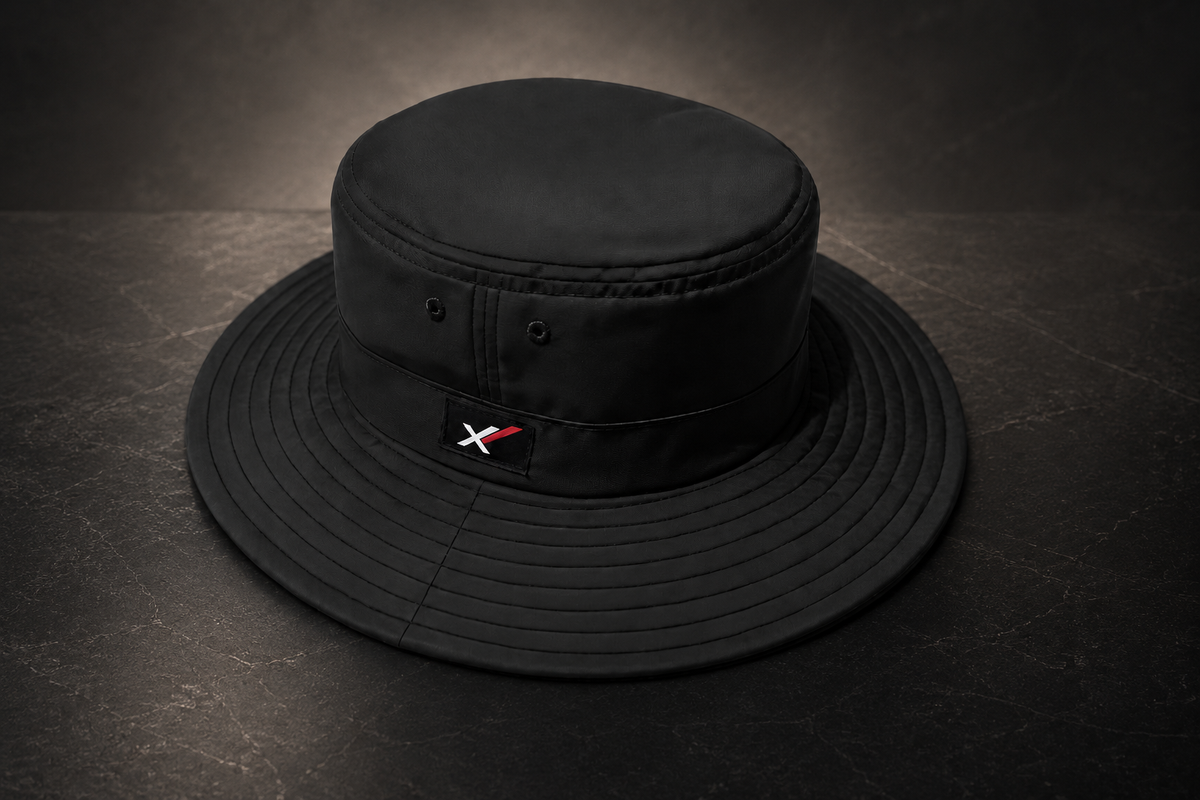
Like the innerwear, these hats feature Trubeaute®, a special fiber embedded with CWO®, a near-infrared absorbing fine particle developed by Sumitomo Metal Mining Co., Ltd. The fabric, which blocks over 76% of near-infrared rays (confirmed by testing at a third-party organization; please see the product page for details on test conditions), protects your head from direct sunlight. The full-brimmed hat design thoroughly covers the back of the neck. Because the functional components are embedded into the fibers, the effect is semi-permanent, even after sweating and washing.
Scheduled for release on July 25, 2026. CORE SHIELD Bucket Hat Product Page
Summary
- The head is one of the biggest entry points for heat, receiving solar radiation at a perpendicular angle for the longest time.
- Think of hat selection not by color, but by "does it have heat-blocking fabric" and "can it release trapped heat."
- Use four criteria: "brim width," "breathability," "near-infrared protection," and "fit."
- General UV protection cannot block near-infrared rays, which are the primary cause of rising body temperature.
- It is most rational to block heat entry points with a top-and-bottom set of a hat (head) and innerwear (trunk).
This summer, try upgrading your hat from "a piece of fabric for shade" to "heat-shielding equipment."
Read more: Regarding heat countermeasures at golf courses, our media outlet for senior golfers, "GOLF100," explains in the article What is Dangerous About Summer Golf for Seniors? Why Heatstroke Risk is High and Countermeasures by Age why those in their 60s and 70s become more vulnerable to heat, and offers age-specific advice.